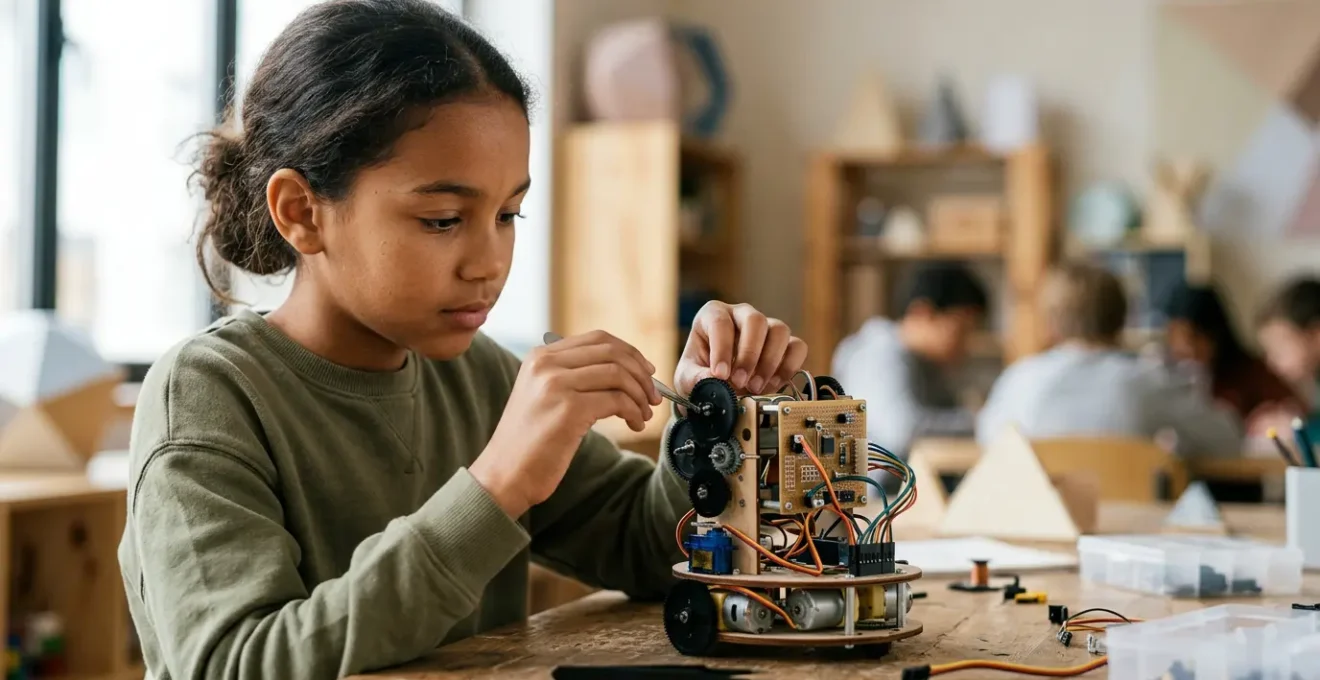
Many parents believe choosing the “right” STEM activity is the secret to keeping their daughters engaged. The truth is, the choice between coding and robotics is secondary. The real key is cultivating a “resilient tinkerer’s mindset” — an approach that reframes failure as useful data and transforms challenges into creative fuel. This shift in perspective is what builds lasting confidence and true problem-solving superpowers.
As parents, we see the spark. The intense focus as she builds a complex LEGO structure, the flash of insight when she solves a tricky puzzle. We know she has the potential to build, create, and solve the world’s future problems. Yet, the path to keeping that spark alive in Science, Technology, Engineering, and Math (STEM) can feel like navigating a minefield. We’re often told the solution lies in picking the perfect activity: should she learn to code, or should she build robots? This question, while well-intentioned, misses the forest for the trees.
According to the iD Tech Education Team, “coding and robotics offer an excellent opportunity for children to develop problem-solving skills, creativity, and critical thinking; developing important skills that can greatly benefit them in the future.” The magic, however, isn’t in the specific tool, but in the process. It’s about how she learns to approach a problem, what she does when she gets stuck, and how she internalizes the thrill of overcoming a challenge. It’s about moving beyond simply following instructions and starting to think like an innovator.
This guide will reframe the debate. Instead of a head-to-head comparison, we will explore a more powerful idea: how to use activities like coding and robotics to nurture a resilient, creative, and joyful approach to problem-solving. We will tackle the confidence crisis head-on, learn how to turn everyday items into a science lab, choose the right tools for the right age, and even transform screen time from a battle into a learning opportunity.
This article provides a complete roadmap for parents looking to foster genuine, long-lasting STEM skills. Let’s explore the key milestones on this journey together.
Summary: Unlocking Your Daughter’s Inner Innovator
- Why girls lose interest in STEM at age 11 and how to prevent it?
- How to extract DNA from a strawberry using only household items?
- Scratch or Python: Which language should your child learn after mastering the basics?
- The purchasing mistake of buying beauty-focused science kits that dumb down the concepts
- When to start a long build: Breaking down a robotics project over 4 weekends?
- Why learning Python is the highest leverage move for a traditional credit analyst?
- Why Roblox is designed to make it physically painful for your child to stop playing?
- How to Implement Screen Time Boundaries for Kids Without Causing a Family War?
Why girls lose interest in STEM at age 11 and how to prevent it?
Around the tender age of 11, something shifts. The same girl who once fearlessly mixed “potions” in the backyard or declared she would be an astronaut suddenly starts saying, “I’m just not a math person.” This isn’t a failure of interest; it’s a crisis of confidence. Research starkly highlights this trend. A 2024 report found that only 59% of girls feel good at math and science, a dramatic drop from 73% in 2017. This isn’t because they’ve become less capable. It’s because societal stereotypes and a lack of visible female role models begin to take their toll.
A 2022 study on the gender gap in STEM confirmed this, finding that girls appeared less confident in their STEM abilities compared to boys, even when their performance was equal. They become more afraid of being wrong, which is poison to the scientific process. Science is built on experimentation, and experimentation is built on the willingness to fail. When failure is seen as a judgment of ability rather than a data point, girls opt out.
To counter this, we must actively build a resilient tinkerer’s mindset. The goal is to reframe challenges and celebrate the learning that comes from mistakes. Here are some strategies parents and educators can use:
- Provide Engaging, Hands-On Projects: Move beyond worksheets. 3D printing, hands-on experiments, and building projects have been proven to retain girls’ interest far more effectively.
- Champion Mentors and Role Models: Expose her to women in STEM, whether in your community or through online resources. Seeing someone who looks like her succeeding makes the path feel achievable.
- Encourage Parental Involvement (Especially Dads!): Research shows that girls who are encouraged by their parents, particularly fathers, are twice as likely to stick with STEM.
- Reframe “Failure”: This is the most crucial step. Teach her that it’s okay to be uncomfortable not knowing the answer immediately. Talk openly about your own mistakes and what you learned from them. Turn “I can’t do it” into “I haven’t figured it out *yet*.”
By focusing on resilience over right answers, we give girls the emotional and intellectual tools to stay in the game, long after the initial spark of interest.
How to extract DNA from a strawberry using only household items?
One of the best ways to build a tinkerer’s mindset is to show that science isn’t something that only happens in a sterile lab with expensive equipment. It’s everywhere, even in your kitchen fruit bowl! A fantastic, high-impact experiment is extracting DNA from a strawberry. It sounds complex, but it uses simple household items and delivers a “wow” moment that makes abstract biology tangible.
This experiment is a perfect micro-lesson in the scientific process. You’ll need a strawberry, dish soap, salt, rubbing alcohol (chilled), and a Ziploc bag. The process involves mashing the fruit (physical breakdown), adding a soap and salt solution (to break open the cell walls), and then using cold alcohol to make the DNA itself visible to the naked eye. It’s a bit like a magic trick, but it’s pure science.
As you can see, what you get is a gooey, stringy white substance. That’s it! That’s the blueprint of life, pulled from a simple piece of fruit. For a child, seeing this makes the concept of DNA real and accessible. It’s no longer just a word in a textbook; it’s something they have personally isolated. This sense of discovery is a powerful confidence booster and turns the kitchen into a place of wonder.
Encourage her to ask “why”: Why the soap? Why cold alcohol? Looking up the answers together extends the learning and reinforces that curiosity, not just getting the right result, is the heart of science.
Scratch or Python: Which language should your child learn after mastering the basics?
Once your daughter is excited about creating with technology, the question of tools becomes more relevant. For younger kids (ages 8-11), Scratch is the undisputed champion. It’s a visual, block-based language developed by MIT that makes it impossible to make a syntax error. Kids can create games, animations, and stories by dragging and dropping colorful blocks of code, allowing them to focus purely on logic and creativity without the frustration of typos.
But what comes next? When she’s ready for a new challenge, the clear answer is Python. Transitioning from the visual world of Scratch to a text-based language like Python is a major step. It introduces the rules of syntax and structure that professional developers use every day. While the learning curve is steeper, the payoff is immense. Python is a powerful, versatile language used in everything from AI and data science to web development and game creation. Coding education specialists find that children who have a solid foundation in Scratch can learn Python 30-40% faster than their peers.
Here is a quick breakdown of how these two languages compare for young learners:
| Aspect | Scratch | Python |
|---|---|---|
| Programming Type | Visual block-based (drag-and-drop) | Text-based (typed code) |
| Best Age Range | 6-11 years | 12+ years (or 10+ with prior Scratch experience) |
| Learning Curve | Low – no syntax errors possible | Higher – requires understanding syntax rules |
| Real-World Application | Educational tool, limited professional use | Professional language used in AI, web development, data science |
| Project Types | Games, animations, interactive stories | Apps, data analysis, automation, AI projects |
| Transition Readiness | Foundation for all coding concepts | Requires prior understanding of programming logic |
The journey from Scratch to Python isn’t just about learning to code; it’s a journey from playful creation to building real-world tools. It’s a powerful step that shows her that her skills have value and application far beyond the classroom.
The purchasing mistake of buying beauty-focused science kits that dumb down the concepts
In the well-intentioned rush to make STEM appealing to girls, a whole industry of “pink-washed” science kits has emerged. Think perfume-making labs, lip balm chemistry sets, and bath bomb factories. While these might seem like a fun entry point, they often commit a cardinal sin: they use science as a decorative theme for a craft project, dumbing down the core principles and reinforcing the very stereotypes we’re trying to break.
The problem with these kits is that they often focus on a “paint-by-numbers” approach. You mix bottle A with powder B to get a pink, sparkly result. The “why” is completely lost. There’s no room for experimentation, no discussion of chemical reactions, and no connection to what a real chemist or materials scientist does. It sends a subtle but damaging message: science for girls is about making pretty things, while science for boys is about building rockets and robots. This is a critical purchasing mistake that can inadvertently diminish a girl’s intellectual curiosity.
To avoid this trap, parents need to become discerning consumers, looking for kits that respect their daughter’s intelligence. A rigorous kit isn’t about the color of the box; it’s about the quality of the learning inside.
Discerning Parent’s Checklist for Evaluating Science Kits:
- Explains the ‘Why’: Does the kit teach underlying scientific principles (e.g., polymer chains, acid-base reactions), not just guide surface-level activities?
- Allows for Experimentation: Does it permit your child to test variables and learn from mistakes, or is it just a set of rigid, follow-along instructions?
- Develops 21st-Century Skills: Does the kit foster genuine problem-solving, creativity, and critical thinking, rather than just assembly?
- Connects to Real Careers: Does it introduce concepts used by actual materials scientists, food chemists, or mechatronics engineers?
- Respects Intelligence: Does the kit challenge your child, or does it use science as a flimsy excuse for a simple craft activity?
The goal is to provide tools that empower her as a scientist, not just decorate her world with science-themed crafts. Choose substance over sparkle, every time.
When to start a long build: Breaking down a robotics project over 4 weekends?
Tackling a big project, like building a programmable robot from scratch, can be incredibly rewarding. It’s also where many kids (and adults!) hit a wall of frustration and give up. The key to success isn’t raw talent; it’s project management. Breaking down a daunting task into small, manageable sprints is a critical skill that professionals use every day, and it’s a perfect technique to teach your daughter.
Instead of seeing a robotics kit as a single, monolithic “build,” reframe it as a four-weekend mission. This approach, borrowed from agile software development, helps maintain momentum and provides regular “dopamine hits” of accomplishment. An organized workspace and a clear plan are your best friends here. A project that feels structured and intentional is far less likely to end in a pile of abandoned parts.
This isn’t about creating a rigid, stressful environment. It’s about providing a scaffold for success. By externalizing the plan, you lower the cognitive load and free up her mental energy to focus on the fun part: problem-solving and creation. Here’s a simple “Agile for Kids” framework for a 4-weekend build:
- Week 1 (Sprint 1): Plan & Gather. Define the goal (e.g., “Build a robot that can follow a black line”). Break it into milestones. Unbox the kit, identify all the parts, and hold a fun “kickoff meeting.”
- Week 2-3 (Sprints 2 & 3): Build & Test Incrementally. Focus on one small win each session. Maybe it’s just assembling the chassis or getting a single motor to spin. Celebrate these small victories.
- Week 4 (Sprint 4): Troubleshoot & Iterate. This is where the real learning happens. When something doesn’t work, treat it as a puzzle. This is where failure becomes data. Celebrate the process of debugging.
- Throughout: The Engineer’s Notebook. Encourage her to keep a notebook (digital or physical) to sketch ideas, document what worked and what didn’t, and track her progress. This teaches structured thinking.
By teaching her how to plan and execute a long project, you’re giving her a superpower that transcends robotics. You’re teaching her how to turn an intimidating mountain into a series of walkable hills.
Why learning Python is the highest leverage move for a traditional credit analyst?
This title might seem oddly specific, but let’s reframe it with a more powerful lens for our daughters: learning a tool like Python is the ultimate “leverage move” for *any* future passion she might develop, whether she becomes an artist, a writer, a scientist, or yes, even a credit analyst. In today’s world, data is everywhere, and Python is the universal key to unlocking its power. Thinking of it as just a “coding language” is a limitation; it’s a problem-solving superpower.
Imagine your daughter loves creating art. With Python, she can write programs to generate mesmerizing fractal patterns or create interactive digital installations. If she’s passionate about social justice, she can use Python to analyze public data sets to uncover hidden inequalities. If she loves writing stories, she could build a simple AI to help her generate plot ideas. Python is widely used in web development, data analysis, artificial intelligence, and scientific computing, making it one of the most versatile and valuable skills a young person can learn.
The “leverage” comes from its ability to automate the tedious and amplify the creative. A credit analyst who knows Python can build a model to assess risk in seconds, a task that might take days manually. This frees them up for higher-level strategic thinking. For your daughter, this means that no matter what field she chooses, knowing Python will allow her to work smarter, solve more interesting problems, and bring her unique ideas to life in ways that others can’t.
Teaching her Python isn’t about forcing her into a tech career. It’s about giving her a powerful tool to be better at whatever she chooses to be, making her more effective, more creative, and more valuable in any path she follows.
Why Roblox is designed to make it physically painful for your child to stop playing?
The title is provocative, but it points to a crucial truth: many digital platforms, including games like Roblox, are masterfully engineered to hold our attention. They use psychological hooks like daily rewards, incomplete progress bars, and social pressures that can make logging off feel like a genuine loss. For parents, this can be a source of conflict. But what if, instead of just fighting it, we used it as a teaching moment?
This is a perfect opportunity to shift your daughter from a passive consumer into a critical analyst. The same logical thinking she uses to build a robot or code a game can be used to deconstruct the very apps she uses every day. This teaches her a vital 21st-century skill: media literacy and an understanding of ethical design. It’s the difference between being controlled by technology and being in control of it.
You can turn her screen time into an analytical exercise. Sit with her and use her expertise as a player to deconstruct the game’s design. This empowers her, values her knowledge, and teaches her to see the systems behind the fun. Here’s how you can guide the conversation:
- Identify the Hook: Ask, “What specific thing in this game makes you want to play just one more round? Is it a daily streak? A treasure chest that opens in an hour?”
- Map the Engagement Loop: Have her draw the cycle: What’s the trigger (e.g., a notification)? What’s the action (playing a round)? What’s the reward (coins, points)? How does that reward make you want to start over?
- Analyze the Ethics: This is a powerful step. Ask, “Could this game be just as fun without making you feel like you *have* to play? How would you design it differently?” This introduces the concept of ethical design versus manipulative design.
- Create with Awareness: Challenge her to use the Roblox creation tools to build a game that’s fun but also respects the player’s time. This connects her coding skills with a sense of responsibility.
By doing this, you’re not just managing her screen time; you’re teaching her to be a more conscious and empowered digital citizen, armed with the ability to see and question the world around her.
Key takeaways
- The drop-off of girls in STEM around age 11 is primarily a crisis of confidence, not competence.
- Reframing “failure” as “data” and cultivating a resilient tinkerer’s mindset is more important than the specific activity chosen.
- Focus on the quality of screen time (creation, connection) over the quantity (passive consumption) to foster healthy tech habits.
How to Implement Screen Time Boundaries for Kids Without Causing a Family War?
The screen time debate is a flashpoint in almost every modern family. The numbers are staggering: a 2024 study found that teens average 8 hours of screen time daily, with preteens not far behind. Simply banning or severely restricting screens often backfires, leading to conflict and secret usage. A more effective and peaceful approach is to shift the conversation from quantity to quality. Not all screen time is created equal.
Collaborating with your child to create a “screen time framework” can transform you from enforcer to partner. The goal is to help them become more mindful of *how* they are using their time, empowering them to make better choices. An hour spent coding a project, video-chatting with grandparents, or researching a school presentation is vastly different from an hour spent passively scrolling through videos. Acknowledging this difference is the first step toward peace.
By creating categories, you can set boundaries that feel logical and fair, not arbitrary. This teaches them to self-regulate and prioritize high-value activities. Here is a helpful framework to discuss and adapt with your family:
| Screen Time Category | Description | Management Strategy |
|---|---|---|
| Passive Consumption | Watching YouTube videos, scrolling social media, passive viewing | Set strict limits; encourage reduction through collaborative goal-setting |
| Active Creation | Coding projects, making digital art, creating content, building in Minecraft | Encourage and support; minimal restrictions if balanced with physical activity |
| Social Connection | Video calls with family/friends, collaborative online learning, mentorship sessions | Facilitate and prioritize; ensure genuine interaction over superficial engagement |
| Educational Engagement | Interactive learning apps, online courses, research for projects | Support with co-viewing when possible; discuss and reinforce learning points |
This approach moves beyond simple time limits and fosters a lifelong skill: the ability to use technology purposefully and mindfully, a cornerstone of a healthy relationship with the digital world.