In summary:
- Deregistering your child is a legal notification, not a request for permission. Understanding your rights is key.
- A formal, concise letter to the headteacher citing the correct legislation is all that is required to begin.
- The initial “deschooling” phase is a vital period for your child to recover from school pressures and rediscover their love of learning.
- You are not legally required to grant home visits or follow the national curriculum; your duty is to provide a suitable education.
The thought of removing your child from the school system can feel daunting. For parents whose children are struggling with anxiety, unmet SEN needs, or the general pressures of school life, it often comes after a long period of stress and worry. You’ve likely heard the common concerns: what about socialisation? Will they fall behind academically? How will I manage it all?
These questions, while valid, often stem from a misunderstanding of what home education is and the legal framework that protects it in the UK. The mainstream view often misses the nuance, focusing on perceived deficits rather than the profound benefits of a tailored, child-centred approach. Many parents feel they need to replicate school at home, buying expensive curriculums and enforcing a rigid timetable.
But what if the true path to a successful home education journey isn’t about replicating school, but about strategically dismantling it? The key lies in understanding that deregistration is not a retreat but a powerful act of educational sovereignty. It’s about taking back control to provide an environment where your child can heal, thrive, and learn in a way that respects their individual needs and pace. This guide is designed to empower you with the precise knowledge of your rights and the practical steps to confidently and legally begin this new chapter.
We will walk through the entire process, from debunking common myths and understanding the crucial ‘deschooling’ phase to the practicalities of drafting your formal notification and managing interactions with officials. This article provides the clear, reassuring roadmap you need to move forward.
Summary: Your Guide to Confident Deregistration and Home Education
- Why home-educated kids often have better social skills than school-based peers?
- Curriculum-based or Child-led: Which approach suits a child recovering from school trauma?
- How to draft the formal letter to the headteacher to ensure immediate removal?
- The boundary mistake where parents let welfare officers into the home without cause
- When to book GCSEs: The 6-month deadline you must meet to find an exam centre?
- Time-Out or Time-In: Which technique builds better long-term emotional resilience?
- Scratch or Python: Which language should your child learn after mastering the basics?
- Coding or Robotics: Which STEM Activity Builds Better Problem-Solving Skills for Girls?
Why Home-Educated Kids Often Have Better Social Skills Than School-Based Peers?
One of the most persistent myths surrounding home education is the question of “socialisation.” The image of a lonely, isolated child is a powerful deterrent for many parents. However, this concern is largely unfounded and often reflects a misunderstanding of what genuine social development entails. School provides constant contact with same-age peers, but this is an artificial construct that doesn’t exist in the real world. True social skill is the ability to interact respectfully and effectively with people of all ages, backgrounds, and positions.
Home-educated children often experience a far more diverse and realistic social environment. They interact with adults in shops, librarians, museum guides, and volunteers at community groups. They learn alongside younger and older children in home education co-ops and during activities. This “vertical” socialisation is arguably more valuable for real-world integration than the “horizontal” socialisation of a single-age classroom. Research consistently supports this reality. For instance, a notable study comparing home-educated and conventionally schooled children found that on social skills assessments, home-educated children’s mean standard score was 113.12, significantly higher than the 107.15 scored by their schooled peers.
Furthermore, qualitative research in the UK by Jennifer Alburey reinforces this. Her work revealed a highly sociable and visible community of home-educated children who were engaged in a wider variety of groups than would typically be available in school. This engagement provides them with more opportunities to develop the confidence and communication skills needed to navigate diverse social situations. The fear of social isolation is a ghost; the reality is often a vibrant, connected, and socially adept child.
This diverse social exposure, free from the confines of peer pressure and playground politics, allows children to develop a stronger sense of self, which is the very foundation of confident social interaction.
Curriculum-Based or Child-Led: Which Approach Suits a Child Recovering from School Trauma?
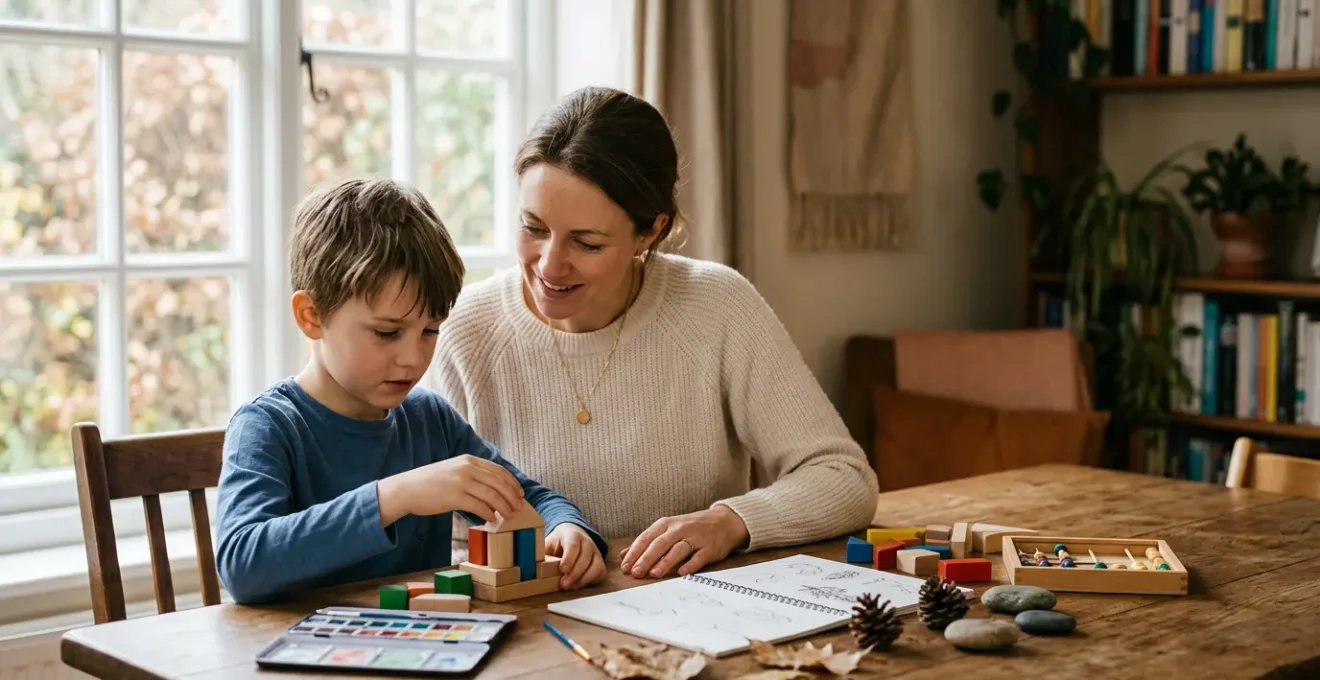
For a child withdrawn from school due to anxiety, bullying, or unmet needs, the immediate priority is not academics but healing. Plunging them into a structured, curriculum-based “school-at-home” model can be counterproductive, replicating the very pressures they needed to escape. This is where the concept of “deschooling” becomes essential. It is a deliberate, therapeutic decompression period where all formal learning is put on hold. It’s a time for the child to de-stress, reconnect with their interests, and, most importantly, rediscover that learning can be joyful and self-directed.
The length of this period varies, but many home education experts suggest a recovery period of up to one month per year of schooling may be needed for a child to shed the institutional mindset. During this time, a child-led discovery approach is almost always the most beneficial. This isn’t about neglecting education; it’s about trusting the child’s innate curiosity. It means following their lead, whether it leads to a deep dive into video game design, ancient history, or baking. As one expert group notes, this process is about more than just relearning how to learn. As Home-Education.org.uk states in their guidance:
Sometimes a child may have been traumatised by their school experiences. In these kinds of circumstances the process of deschooling is not limited to relearning how to learn, its learning how to trust in their own safety again.
– Home-Education.org.uk, Deschooling guidance document
By allowing the child to direct their own path, you are sending a powerful message: their interests are valid, their mind is capable, and their emotional wellbeing is the priority. This foundation of trust and safety is what makes all future learning possible. A formal curriculum can always be introduced later, if and when it feels right for your child.
Ultimately, this period of deschooling is an investment in your child’s long-term mental health and their relationship with learning, setting the stage for a more sustainable and fulfilling educational journey.
How to Draft the Formal Letter to the Headteacher to Ensure Immediate Removal?
The single most important step in beginning your home education journey is the deregistration letter. This is an area where clarity and precision are vital. It is crucial to understand that this letter is not a request for permission; it is a formal notification of a decision you have made. In England and Wales, if your child is attending a mainstream school (not a special school), you have the absolute legal right to do this. The school has no power to refuse.
Your strategic communication should be formal, professional, and concise. It needs to contain specific information to fulfil your legal duty and ensure the school acts immediately. There is no need for lengthy explanations, justifications, or emotional content. The goal is to state your intention clearly, reference the relevant law, and create a clear paper trail. Once the school receives this letter, they are legally obligated to remove your child’s name from the school roll immediately.
After you send the letter, the school’s duty is to inform the Local Authority (LA). It is common for schools not to reply or acknowledge your letter. While this may seem impolite, it is normal. Your legal duty is complete once the letter is sent and received. You are not required to chase the school for confirmation. Understanding this process helps manage expectations and reduces anxiety.
Your Deregistration Audit Checklist
- Points of contact: Confirm the full name and correct email/postal address for the headteacher and school office.
- Collecte: Gather all required data for the letter: child’s full name, date of birth, and the specific legal clauses (Education Act 1996, Section 7).
- Cohérence: Proofread the letter’s content, ensuring it is a clear, unambiguous statement of withdrawal for home education, not a request.
- Mémorabilité/émotion: Review the letter’s tone. Ensure it is formal, polite, and completely free of emotional language or justification.
- Plan d’intégration: Decide on the delivery method (e.g., email with read receipt, registered post) to create proof of receipt and note the date sent.
By following this structured approach, you ensure the transition is legally sound and stress-free, allowing you to focus on your child’s needs from day one.
The Boundary Mistake Where Parents Let Welfare Officers Into the Home Without Cause
Once you have deregistered, the Local Authority (LA) will be notified, and they will likely make contact. This is often the most anxiety-inducing part of the process for new home educators. It’s essential to understand the legal relationship: your duty is to provide a suitable education, and the LA’s duty is to intervene only if it appears that you are not. They have no automatic right of entry into your home.
A common mistake born of a desire to seem cooperative is to agree to a home visit from an Education Welfare Officer (EWO) without question. While these visits are often framed as informal chats or supportive check-ins, you are not legally required to grant them. This is a critical aspect of boundary management. Your home is your private space, and you have the right to control who enters it. Allowing officials in can set a precedent and create a dynamic where you feel you are being constantly monitored and judged.
The most effective strategy is to keep all communication in writing. This creates a clear record and prevents misinterpretation of conversations. If an officer calls or arrives at your door unannounced, you can politely but firmly state your preference for written correspondence. You are not being uncooperative; you are simply exercising your right to manage the process in a way that protects your family’s privacy. You can fully demonstrate the suitability of your provision through a written report, philosophy statement, and samples of your child’s work.
Here are some polite but firm ways to handle doorstep encounters:
- “Thank you for coming, but this isn’t a convenient time. Could you please put any questions you have in an email/letter?”
- “We prefer to handle all communications with the authority in writing for clarity. I look forward to hearing from you via email.”
- “I’m not available to talk right now, but you can find our contact details to write to us. Have a good day.”
Remember, you are the educator, and you are in a partnership of equals with the LA, not a subordinate. Establishing this dynamic from the outset is key to a long and peaceful home education experience.
When to Book GCSEs: The 6-Month Deadline You Must Meet to Find an Exam Centre?
As your child progresses, the question of formal qualifications like GCSEs will naturally arise. This can feel like a significant hurdle, but with forward planning, it is entirely manageable. The key difference for home educators is that you are responsible for finding and registering your child as a “private candidate” at an exam centre that accepts them. This is a purely logistical challenge, not an academic one.
The most critical piece of advice is to start early. Many exam centres have deadlines for private candidate registration that are far earlier than those for their own students. A general rule of thumb is to begin your search and make contact with potential centres at least six to nine months before the exam season (which typically starts in May/June). This means you should be finalising your arrangements in the autumn of the academic year your child will sit the exams. Waiting until the spring is often too late, as places fill up quickly.
Before you even worry about the logistics, however, it’s worth taking a moment to consider the long-term outcomes. The pressure to achieve a certain number of GCSEs can feel immense, but home education provides a unique opportunity to focus on deep learning and genuine interest, which are better predictors of future success. The data strongly supports the long-term viability of this path. For those concerned about higher education prospects, reassuringly, research shows that 66.7% of homeschooled children progress to graduate from college, demonstrating that this educational route is a robust pathway to academic and professional success.
Therefore, approach GCSEs as a project to be managed: research local exam centres, understand their fees and deadlines, and build a relationship with the exams officer. It’s a practical task, not a barrier to your child’s bright future.
Time-Out or Time-In: Which Technique Builds Better Long-Term Emotional Resilience?
The journey of home education, especially after a difficult school experience, is as much about emotional recovery as it is about academic learning. How you handle challenging behaviour and big emotions will profoundly shape your child’s ability to build resilience. The traditional “Time-Out” method, which involves sending a child away to be alone, can inadvertently send the message that they are “bad” and must be isolated when their emotions are overwhelming.
A more effective and connection-focused alternative is “Time-In.” Instead of isolation, Time-In involves creating a calm, safe space where you and your child can be together to co-regulate. It’s about moving *towards* your child in their moment of distress, not pushing them away. This might look like sitting quietly together, offering a hug, or simply being a calm presence until they are ready to talk. This approach teaches a vital lesson: that difficult feelings are manageable and that connection is the antidote to emotional turmoil.
This focus on emotional wellbeing is not a “soft” alternative to academics; it is the very foundation upon which academic success is built. Children who feel safe, seen, and understood are better equipped to learn. As the Association of Directors of Public Health noted in a key report:
“Children with higher levels of emotional, behavioural, social and school wellbeing have higher levels of academic achievement on average.”
– Association of Directors of Public Health, Children’s mental health and wellbeing report
For a child recovering from school trauma, “Time-In” is a micro-form of the deschooling process. It is a period of ‘reintegration’ into a state of emotional safety. By choosing connection over isolation, you are not just managing a moment of difficult behaviour; you are actively building the neural pathways for emotional regulation and resilience that will serve your child for the rest of their life.
This technique reinforces that your relationship is the most important teaching tool you have, creating a secure base from which all exploration and learning can begin.
Scratch or Python: Which Language Should Your Child Learn After Mastering the Basics?
Once your child has settled into home education and their natural curiosity has been rekindled, you may find them drawn to specific, high-value skills like coding. In a child-led environment, this interest is a golden opportunity. A common starting point is a visual block-based language like Scratch, developed by MIT. It’s intuitive, fun, and allows children to see the results of their logic immediately in the form of games and animations. But what comes next?
The natural progression from Scratch is often to a text-based language, with Python being one of the most popular and versatile choices. The transition from visual blocks to written syntax is a significant cognitive leap. The choice between sticking with Scratch or moving to Python depends entirely on your child’s goals and learning style. Is their passion in creative media and game design, where Scratch’s visual nature is a strength? Or are they drawn to the analytical power and real-world applications of Python, which is the backbone of everything from data science to artificial intelligence?
There is no “better” language, only the language that best aligns with your child’s interests. The home education advantage is the flexibility to allow a child to master one platform or transition to another at their own pace, without being constrained by a school’s curriculum. The following table breaks down the different pathways and applications for these two excellent tools.
This comparative overview, based on principles of aligning tools with child-led learning, can help you guide your child’s next steps.
| Aspect | Scratch | Python |
|---|---|---|
| Primary Pathway | Creative media, game design, animation | Data science, AI, engineering |
| Learning Style | Visual, block-based coding | Text-based, syntax-focused |
| Complexity Level | Beginner to intermediate | Intermediate to advanced |
| Home Education Advantage | Project-based, immediate visual feedback | Real-world applications, professional skills |
| Interest Alignment | Best for creative, visual learners | Best for analytical, logic-oriented learners |
| Transition Strategy | Can be bridged to Python through porting projects | Can start with Scratch concepts first |
Ultimately, the goal is not to turn them into a professional coder overnight but to nurture the problem-solving skills, logical thinking, and persistence that learning any programming language develops.
Key Takeaways
- Deregistration is a legal right, not a request; a formal letter is a notification, not a plea.
- “Deschooling” is a crucial recovery period, prioritising your child’s emotional wellbeing over immediate academic pressure.
- You have the right to manage all interactions with the Local Authority in writing, and home visits are not a legal requirement.
Coding or Robotics: Which STEM Activity Builds Better Problem-Solving Skills for Girls?
As you embrace the freedom of home education, you have a unique opportunity to foster a love for STEM (Science, Technology, Engineering, and Maths) free from the gender stereotypes that can still persist in classrooms. Activities like coding and robotics are not just about learning technical skills; they are powerful engines for developing critical thinking, resilience, and creative problem-solving. But which is better for building these skills, particularly for girls who may have been discouraged from these fields?
The answer is that the “better” activity is whichever one captures your child’s imagination. Both coding and robotics offer a tangible way to see logic in action. Coding offers the magic of creating worlds and tools from pure text, while robotics adds the physical dimension of making something move and interact with its environment. The key is not the specific tool but the underlying process: identifying a problem, hypothesizing a solution, testing it, and debugging when it fails. This iterative loop of trial and error is the heart of all problem-solving.
The most profound way to build these skills is to follow the principles of child-led discovery. When a child chooses their own project, their motivation is intrinsic. They are not learning to pass a test; they are learning because they desperately want to make their character jump higher or their robot navigate a maze. This passionate engagement is what builds true mastery and resilience. The specific subject matter becomes almost secondary to the skills being developed.
Case Study: The Power of Child-Led Discovery
A parent shared the story of deregistering their severely dyslexic son who was failing at school. After finding that all formal workbooks failed, they embraced a child-led approach. The boy watched a history YouTube video, which sparked a week-long deep dive into the topic through documentaries, audiobooks, and drawing. He had left school in Year 4, barely able to do Reception-level work, yet he was now passionately learning and retaining complex information because it was driven by his own curiosity. This family’s success came from abandoning the school model and trusting their child’s own educational instincts.
Your role is to facilitate this discovery, providing the resources, encouragement, and freedom for your child to explore, fail, and ultimately, succeed on their own terms. This is the true gift of educational sovereignty.