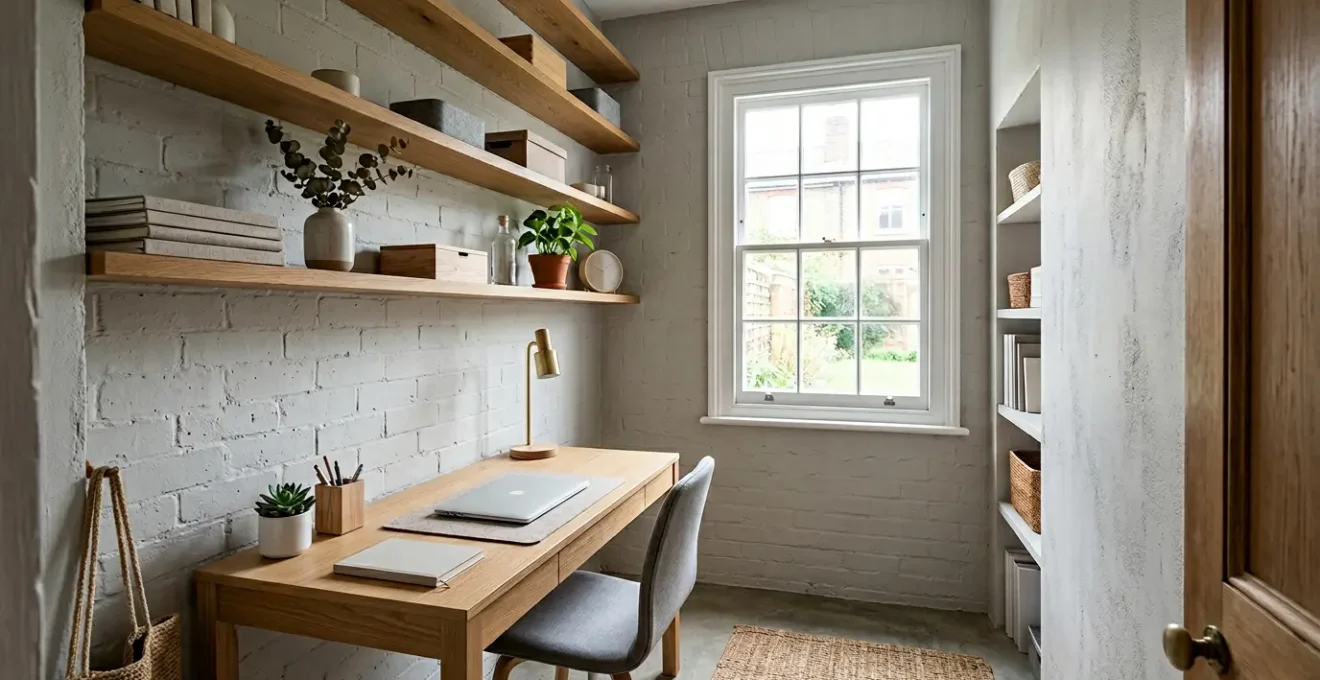
Designing a functional office in a tiny box room is not about compromise; it’s about mastering spatial geometry to unlock its true three-dimensional potential.
- Effective storage isn’t just about shelves; it’s a matter of claiming the full vertical volume of the room to eliminate floor clutter.
- Desk and chair selection is a game of “dimensional footprints,” where the physical space an object occupies is more critical than its style.
Recommendation: Stop thinking about what furniture can fit inside the room. Start thinking like an architect about how to reshape the space itself for focus and productivity.
Ah, the classic British “box room.” That small, often-forgotten third bedroom in a typical terrace house, measuring barely more than two metres squared. For many, it becomes a reluctant storage space, a graveyard for items without a home. Now, with the rise of remote work, the pressure is on to transform this compact cell into a professional, productive home office. The internet is flooded with well-meaning but ultimately superficial advice: “paint it white to feel bigger,” “buy multi-functional furniture,” or “keep it tidy.”
These tips scratch the surface but fail to address the fundamental challenge. Cramming a desk and chair into a tiny room often results in a space that is neither a functional office nor a restful room—it’s a compromise that serves neither purpose well. But what if the solution wasn’t finding smaller objects to fit, but fundamentally rethinking the geometry of the space itself? As an interior architect specialising in compact living, I see these rooms not as limitations, but as volumetric puzzles waiting to be solved. The key isn’t to shrink your needs, but to expand your spatial thinking.
This guide moves beyond generic tips. We will deconstruct the box room, piece by piece, applying architectural principles to solve its inherent spatial problems. We’ll explore how to manage volume, control light, select furniture with a dimensional awareness, and ultimately, architect a workspace that is as functional and inspiring as an office many times its size.
Summary: How to Create a Functional Home Office in a Small 3-Bed Terrace Box Room?
- Why floor-to-ceiling shelving is the only way to keep a 5m² room clutter-free?
- How to position your desk to get natural light without glare on your monitor?
- Bespoke built-in or Flat-pack: Which desk solution adds value to your property?
- The chair selection mistake that causes back pain for 50% of box room workers
- When to use a fold-down desk: Converting the office back to a guest room in 2 minutes?
- Hot Desk or Dedicated: Which membership type boosts productivity for freelancers?
- When to drink your last coffee: The 90-minute window after waking up?
- City HQ vs Local Coworking: Which Hybrid Model Saves More Money for Employees?
Why floor-to-ceiling shelving is the only way to keep a 5m² room clutter-free?
In a small room, floor space is a precious commodity. The common mistake is to treat storage as an afterthought, placing a standard bookcase against a wall. This approach is a failure of spatial imagination. A typical bookcase only utilizes the middle portion of a wall, leaving the upper third of the room’s volume completely dead. This isn’t just inefficient; it visually shortens the room and encourages clutter to spill onto other surfaces. It’s a universal problem, with one survey finding that 42% of Americans feel cluttered at home.
The architectural solution is to shift your thinking from two-dimensional floor plans to three-dimensional volumetric efficiency. Floor-to-ceiling shelving is the only strategy that fully accomplishes this. By drawing the eye upward along a single, continuous vertical plane, you create an illusion of height and order. More importantly, you consolidate all storage—books, files, equipment—into one designated zone, liberating the rest of the room from clutter. This single move transforms the room’s function from a storage container into a defined workspace.
This doesn’t have to mean expensive custom carpentry. Modular systems like the IKEA IVAR are a designer’s secret weapon. As one home office creator demonstrated, these systems can be configured to climb the full height of a wall, turning awkward corners into highly valuable storage real estate. The goal is to create a ‘library wall’ that feels like an intentional, integrated part of the room’s architecture, not just a piece of furniture. It is the single most powerful step you can take to establish order in a compact space.
How to position your desk to get natural light without glare on your monitor?
Natural light is essential for well-being and productivity, but in a small office, the window is both an asset and a liability. Poor desk placement leads to a constant battle with screen glare, causing eye strain and headaches. Many people instinctively face the window for the view or place it directly behind them to light their face on video calls. Both are critical errors in what I call light geometry. Facing a window creates intense backlight, forcing your eyes to constantly adjust between a bright outside and a dimmer screen. A window behind you is the primary cause of screen glare.
The solution is precise and non-negotiable: your desk should be positioned perpendicular to the window. This means the window is to your side, bathing your workspace in soft, indirect light without shining directly onto your monitor or into your eyes. This simple 90-degree rotation is the cornerstone of ergonomic lighting.
As the diagram above illustrates, this setup solves multiple problems at once. The light falls on your desk and keyboard, not your screen. For video calls, this side-lighting creates a pleasant, professional-looking soft shadow effect, far superior to the silhouette of backlighting or the flat wash-out from front lighting. Of course, you should also adjust your monitor’s brightness to match the ambient light in the room. If reflections persist due to a particularly bright day, adjustable blinds or a simple anti-glare screen protector can provide the final layer of control.
Bespoke built-in or Flat-pack: Which desk solution adds value to your property?
When it comes to the desk itself, the choice often boils down to a quick-fix flat-pack solution or a more considered bespoke built-in. From a purely functional standpoint, both can work. But from an architectural and property value perspective, the difference is profound. A flat-pack desk is an object *in* the room; a bespoke built-in becomes part of the room itself. This concept of spatial permanence is what separates mere furnishing from interior design.
A built-in desk, designed to fit the specific dimensions of your box room, turns an architectural constraint into a feature. It can flow seamlessly into shelving, wrap around an awkward corner, or create a floating effect that maximizes floor space underneath. This level of integration makes the home office feel intentional, permanent, and luxurious—qualities that are highly attractive to potential buyers. As the experts at Raleigh Woodworks note, a dedicated, stylish home office is a significant draw in the modern property market.
A dedicated, stylish home office is a huge draw for hybrid workforce. Built-in desks, bookshelves, and cabinets can turn an unused corner or bedroom into a productivity haven — and buyers will notice.
– Raleigh Woodworks, Room-by-Room ROI Breakdown for Homeowners
This isn’t just a feeling; it’s a financial reality. While a flat-pack desk is a disposable expense, a well-executed built-in is an investment. In fact, reports on renovation ROI consistently show that minor interior projects focused on improving function and layout can be surprisingly lucrative. According to some analyses, these improvements can yield a return on investment of between 50% to 80%. By architecting a permanent workspace, you’re not just creating a place to work; you’re adding tangible, marketable value to your home.
The chair selection mistake that causes back pain for 50% of box room workers
The conversation around office chairs is rightly focused on ergonomics—lumbar support, adjustability, and posture. Yet, in the context of a 2x2m box room, there is a far more fundamental mistake being made, one that has nothing to do with the shape of the backrest. The critical error is ignoring the chair’s dimensional footprint. A large, executive-style ergonomic chair, however comfortable in a spacious office, becomes a destructive force in a compact space. The problem is widespread; a study of European workers found that 67% experience pain from their workstation, with back pain being the top complaint.
In a box room, the diameter of the chair’s five-star base and the width of its armrests are as important as its ergonomic features. A base that is too wide will constantly collide with walls or the legs of the desk. Fixed, wide armrests will prevent the chair from tucking neatly under the desk, stealing valuable floor space and creating a trip hazard. This constant, low-level spatial conflict creates frustration and can even discourage proper use, leading you to perch on the edge of the seat just to get closer to the desk.
The architect’s choice is a chair designed for high performance in tight quarters. Look for models with a smaller base diameter (under 60cm is ideal) and, crucially, flip-up or fully adjustable armrests. This allows the chair to be pushed completely under the desk when not in use, instantly reclaiming a square metre of floor space and restoring a sense of openness to the room. It’s the perfect marriage of high-level ergonomics and small-scale spatial intelligence.
Your 5-Point Box Room Chair Audit
- Measure the Base: Get out a tape measure. Is the diameter of the five-star base 60cm or less? Anything more will create conflict in a small room.
- Check the Armrests: Do they flip up, or can they be lowered to sit flush with the seat? This is non-negotiable for tucking the chair away.
- Assess Seat Depth: Can you adjust the seat depth? A shallow seat pan can be a huge space-saver while still providing proper thigh support.
- Evaluate Caster Type: Are the wheels suitable for your flooring (hard casters for carpet, soft for wood/laminate)? The wrong type makes small movements difficult and frustrating.
- Test the Swivel: Sit in the chair and perform a full 360-degree swivel. Do you hit a wall, a desk leg, or a cabinet? This is the ultimate test of its dimensional footprint.
When to use a fold-down desk: Converting the office back to a guest room in 2 minutes?
The fold-down or “murphy” desk is often presented as the ultimate solution for multi-use small rooms. The marketing promise is seductive: a full office that vanishes in moments, instantly converting the space back into a guest room or playroom. However, as an architect, I urge caution. The reality of these transformational mechanics often involves significant compromises in stability, size, and convenience that can undermine the very productivity you seek.
A fold-down desk is, by its nature, less sturdy than a fixed one. It often has a shallower work surface and can feel flimsy under the weight of monitors and daily use. The “2-minute conversion” rarely accounts for the tangle of wires for your monitor, laptop, and chargers, which must be managed every single time. This daily ritual of setting up and tearing down introduces friction into your workday, a small but persistent barrier to simply getting started.
A more sophisticated architectural approach, as seen in some clever small-space designs, is to opt for a permanent but highly space-efficient setup. A slim, fixed desk (perhaps a floating one to maximize floor space) provides stability and a constant “ready-to-work” state. The multi-use functionality is then achieved not by folding the furniture, but through clever storage and mounting solutions. For example, using monitor arms that can be easily pushed back against the wall and clip-on accessories that can be stored away in the vertical shelving unit. This strategy prioritizes the primary function—the office—while still allowing the secondary function—the guest room—to exist without a daily, disruptive transformation.
Hot Desk or Dedicated: Which membership type boosts productivity for freelancers?
In the world of co-working, this question defines your relationship with the space. But the “Hot Desk vs. Dedicated” philosophy is just as critical within the four walls of your home. When you establish an office in a box room, you are not just placing furniture; you are defining its “membership type” for your household. Is this desk a “hot desk”—a free-for-all surface for homework, life admin, and general household use? Or is it a “dedicated desk”—a space exclusively for your professional work?
For a freelancer or remote worker whose income depends on focus, the answer must be dedicated. A hot desk environment at home, where your workspace is constantly being used or disturbed by others, is a recipe for lost productivity. It breaks your psychological ownership of the space. Every time you sit down, you first have to clear away someone else’s clutter, mentally reset the space, and re-establish your focus. This is a constant drain on your cognitive resources.
Treating your small home office as a dedicated desk, on the other hand, builds a powerful mental trigger. The space becomes a sanctuary for deep work. Your monitor is always at the right height, your notebook is where you left it, and the environment is primed for productivity. This requires setting clear boundaries with family members. The box room office is not a public utility; it is your professional headquarters. This shift in mindset, from a shared surface to a private, dedicated workspace, is as crucial as any piece of furniture you buy.
When to drink your last coffee: The 90-minute window after waking up?
This question about caffeine timing might seem out of place in an article about spatial design. However, a truly well-designed space supports the user’s natural rhythms. This is the essence of bio-architecture: creating environments that work with our biology, not against it. How you manage your energy throughout the day is deeply connected to the space you inhabit. Questions like “when to drink coffee” are proxies for a larger issue: “how does my environment support or sabotage my natural focus cycles?”
The popular advice to wait 90 minutes after waking to drink coffee is based on the body’s natural cortisol cycle. By letting your body’s own alerting system do its job first, you get more impact from caffeine later. An architecturally-minded approach would ask: how can the space itself help you honour this? The answer lies in light. Instead of stumbling to the coffee machine, the first action should be to open the blinds in your well-positioned office and let the morning sun energize you naturally, as discussed in our section on light geometry.
Similarly, the question of the *last* coffee is about protecting your sleep. A common reason for a late-afternoon caffeine hit is battling eye strain from poor lighting. A well-designed office with excellent, dimmable, and warm-toned task lighting reduces this strain. It allows you to work comfortably into the late afternoon without needing a chemical stimulant, ensuring your workspace doesn’t disrupt your ability to rest and recharge for the next day. Your office shouldn’t just be a place to work; it should be an ecosystem that helps you manage your energy effectively.
Key Takeaways
- Volumetric Thinking: Don’t just use floor space; claim the full vertical height of the room with floor-to-ceiling storage to eliminate clutter.
- Dimensional Footprints: The physical space a chair occupies (its base and armrests) is more critical in a box room than its aesthetic style. Prioritise a small footprint and flip-up arms.
- Light Geometry: Position your desk at a 90-degree angle to the window. This is the non-negotiable rule for maximizing natural light while eliminating screen glare.
City HQ vs Local Coworking: Which Hybrid Model Saves More Money for Employees?
In a corporate hybrid model, this question involves a commute, office perks, and rental costs. But we can apply this same financial logic to the two most common work-from-home scenarios: working from the “City HQ” (the chaotic kitchen table) versus investing in a “Local Coworking” space (your dedicated box room office). The “money” you save is not in pounds and pence, but in the far more valuable currencies of time and cognitive energy.
Working at the kitchen table is deceptively “free.” In reality, you pay a heavy tax in the form of constant interruptions, background noise, and the mental load of context-switching between your professional tasks and the domestic environment. A task that should take 30 minutes of focused effort can stretch to an hour or more, fragmented by distractions. This is the hidden cost of the “City HQ” model at home.
Investing time and a modest budget to create a dedicated box room office is akin to paying a membership for a local coworking space. It has an upfront cost, but the return on investment is immediate and immense. By closing the door, you create a protected environment for deep work. The “commute” is a few steps, but it’s a powerful psychological transition. The productivity gains are tangible: that 30-minute task now takes 30 minutes. You reclaim hours in your week, reduce stress, and produce higher quality work. The real saving, therefore, is not on rent or travel, but on your most finite resource: focused attention.
Stop seeing a box room and start seeing a blueprint. The constraints of the space are not a barrier but an invitation to be more creative and intentional. By applying these architectural principles, you can craft a workspace that is not just functional, but genuinely transformative for your productivity and well-being. It’s time to architect your focus.