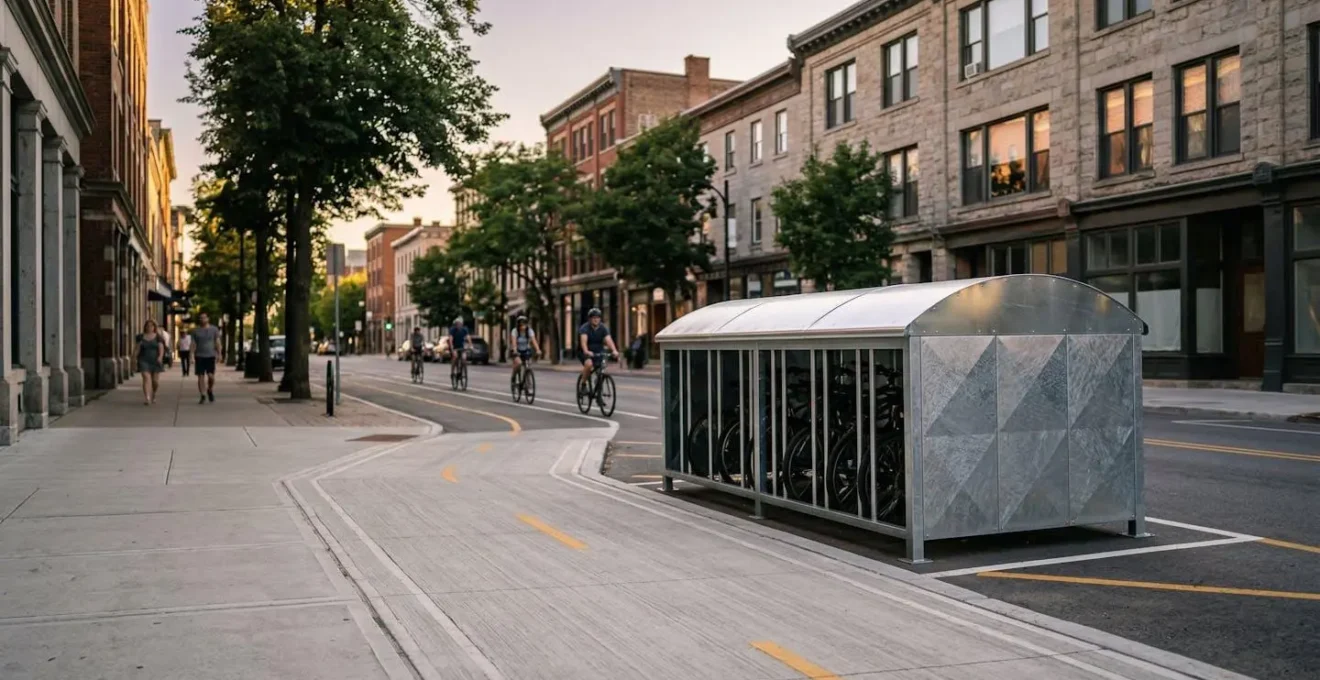
Shifting from car-centric to bike-centric street design isn’t just about parking; it’s a proven strategy for economic growth and community well-being.
- Replacing a single car space with bike parking can significantly boost local retail spending.
- Well-designed, permanent cycling infrastructure consistently increases nearby property values.
- Community-led petitions are a highly effective tool for driving tangible change at the street level.
Recommendation: Focus on advocating for human-scale, permanent infrastructure as a long-term investment in your neighborhood’s health and wealth.
For any cyclist living in a city without a garage, the daily question is the same: where can I leave my bike so it’s still here when I get back? The standard advice—buy a heavy lock, find a well-lit spot, hope for the best—places the entire burden of a billion-dollar criminal enterprise onto the individual. This approach is not only stressful; it’s a fundamental failure of urban design. It treats cycling as an afterthought, an activity to be secured *against* the city, rather than integrated *within* it.
But what if the solution isn’t just a better lock, but a better street? This guide reframes the debate from a simple choice between on-street hoops and basement car parks to a more profound question: how do we, as a community, design public spaces that make cycling the safe, easy, and logical choice? We will move beyond individual security tips to explore the powerful, systemic impact of thoughtful bike storage. As an urban infrastructure designer, I see this not as a cost, but as a strategic investment with measurable returns.
This article will demonstrate the compelling economic case for replacing car spaces with bike racks, provide a practical roadmap for petitioning your local council, and analyze the crucial design details that separate genuinely useful infrastructure from mere street furniture. We’ll uncover how these choices directly influence pedestrian safety, property values, and the overall economic vitality of our neighborhoods. It’s time to stop just locking our bikes and start re-engineering our cities.
To navigate this strategic approach, this guide breaks down the essential components, from the economic data that convinces decision-makers to the specific design choices that ensure infrastructure is safe and accessible for all.
Summary: A Strategic Guide to Urban Bike Infrastructure
- Why replacing one car space with a bike rack increases retail spend on the street?
- How to petition your local council to install a secure bike hangar on your street?
- Sheffield Stand or Two-Tier: Which rack design is easier for elderly or smaller cyclists?
- The design error that puts pedestrians at risk when docking stations are poorly placed
- When to apply for funding: The annual window for council sustainable transport grants?
- Why closing side roads to cars actually increases footfall for local high streets?
- Bespoke built-in or Flat-pack: Which desk solution adds value to your property?
- 15-Minute Cities: How Will Living in Low Traffic Neighborhoods Affect Your Property Value?
Why replacing one car space with a bike rack increases retail spend on the street?
The most common objection to removing car parking is the fear of harming local businesses. The data, however, tells a radically different story. Reallocating a single car parking space—which serves one person at a time—to bike parking that can serve 10-12 cyclists creates an “economic flywheel.” People who arrive by bike tend to make more frequent visits to a wider variety of shops, integrating local commerce into their daily lives rather than making a single, destination-focused trip. This is a shift from transactional visits to relational, community-based spending.
The evidence is compelling. In London, for instance, a landmark study revealed a powerful economic truth: while car drivers might spend more per individual trip, people on bikes are the more valuable customers over time. Transport for London research reveals that people cycling spend 40% more in their local shops each month than those who drive. This isn’t an anomaly; it’s a predictable outcome of designing streets for people, not just for vehicles.
The 2016 pilot program on Toronto’s Bloor Street provides a perfect real-world example. When the city replaced 136 on-street parking spots with a protected bike lane, the initial outcry from some businesses was significant. Yet, a post-implementation economic impact study found their fears were unfounded. Both total customer spending and the number of patrons served by merchants actually increased. This demonstrates that investing in bike infrastructure is one of the most effective forms of direct economic stimulus a city can provide for its local high streets. It attracts more people who spend more money, more often.
Ultimately, a bike rack isn’t just a place to leave a bicycle; it’s a signal to the community that the street is open for business on a human scale.
How to petition your local council to install a secure bike hangar on your street?
Securing council approval for a bike hangar can seem like a daunting bureaucratic challenge, but it is a solvable problem. Success rarely comes from a single email; it comes from demonstrating unified community demand and presenting a data-backed case. As a designer, I’ve seen that councils are far more responsive to organized, evidence-based requests than to isolated complaints. You must shift their perspective from seeing a hangar as an expense to seeing it as a solution to existing problems like street clutter and theft.
The key is to act as a community organizer. Follow a structured approach to build momentum and present a compelling case that politicians and transport officers cannot ignore. The process can be broken down into clear, actionable stages:
- Make Formal Contact: Begin by identifying and contacting your local councillor and the specific council department responsible for transport. This creates an official record of your request.
- Gather Evidence of Demand: This is the most crucial step. Conduct a “bike census” on your street, photographing bikes chained to railings, lampposts, and drainpipes. Create a waiting list of neighbors who commit to renting a space. A list of 20 names carries more weight than one.
- Build a Coalition: Involve local businesses, schools, and residents’ associations. A letter of support from a local café owner or a headteacher demonstrates that the demand extends beyond just a few residents.
- Present Data-Backed Solutions: Map local bike theft hotspots using police data. Show how bikes locked to railings obstruct sidewalks for parents with strollers or wheelchair users. Frame the bike hangar as a direct solution to these pre-existing issues.
- Be Persistent and Strategic: The council process is often slow. Follow up regularly and professionally. Engage with officers months before official application windows open; this groundwork often makes the difference between success and failure.
This exact process led to tangible results in Brighton. In 2020, resident Mark Bason presented a petition after a spate of thefts, triggering a council survey that received over 2,000 requests. This overwhelming public demand led directly to the installation of 60 new hangars, providing 360 secure spaces. It’s a clear demonstration that persistent, organized community agency works.
Your voice, when amplified by your neighbors and backed by evidence, can fundamentally reshape the infrastructure of your own street.
Sheffield Stand or Two-Tier: Which rack design is easier for elderly or smaller cyclists?
When planning bike parking, the choice of rack is not a minor detail; it’s a decision that determines who can and cannot use the facility. The goal of urban design should always be to create inclusive environments. A rack that requires a user to lift the entire weight of their bicycle is a barrier, effectively excluding many elderly riders, smaller adults, or those with heavier e-bikes. As BikeSafe insightfully notes in their analysis:
Traditional racks are best for smaller or more casual sites, or where accessibility comes first.
– BikeSafe Two Tier Rack Comparison, Two-Tier Bike Racks vs. Traditional Bike Racks Analysis
This principle of “accessibility first” is paramount. While two-tier systems are often promoted for their space efficiency, they introduce a physical challenge that can negate their purpose. A direct comparison reveals the stark differences in user experience, especially when considering a full spectrum of cyclists.
| Feature | Sheffield Stand | Two-Tier (Gas-Assisted) | Two-Tier (Manual) |
|---|---|---|---|
| Lifting Weight Required | None – bike rests on ground | Minimal – gas strut supports bike weight | High – user must lift entire bike weight |
| Accessibility for Elderly/Small Cyclists | Excellent – no lifting needed | Good – gas assistance reduces effort | Poor – significant strength required |
| E-bike Compatibility (up to 30kg) | Yes – no weight restrictions | Yes – gas strut handles heavier bikes | No – too heavy for manual lifting |
| Locking Point Accessibility | Easy – frame & wheel at ground level | Moderate – upper tier requires reaching | Difficult – height + manual effort |
| Maneuvering Space Required | 800-1000mm between racks | 1500-2000mm aisle clearance | 1500-2000mm aisle clearance |
| Cognitive Load (Ease of Use) | Intuitive – simple lean-and-lock | Moderate – requires understanding mechanism | Complex – multi-step manual process |
The analysis is clear: for genuine accessibility, the simple, ground-level Sheffield stand is unparalleled. It requires no lifting, accommodates all bike types including heavy e-bikes, and is intuitive to use. While gas-assisted two-tier racks are a good compromise for high-density areas, manual two-tier systems present a significant barrier and should be avoided in public spaces aiming for universal access. Choosing a rack is a statement of priorities: do we prioritize maximizing numbers, or do we prioritize ensuring everyone can participate?
For truly inclusive urban design, the answer must always be the latter. A bike rack that only the strongest can use is not a solution; it’s just another problem.
The design error that puts pedestrians at risk when docking stations are poorly placed
Effective bike infrastructure should solve problems, not create new ones. A common and dangerous design error is placing bike racks and docking stations without considering the natural flow of pedestrian movement. When a rack is installed in a way that blocks a “desire line”—the most direct walking route between two points—it forces pedestrians into unsafe paths, often closer to traffic or into blind spots. This creates a conflict where there should be harmony, pitting the needs of cyclists against the safety of pedestrians, particularly the most vulnerable.
This isn’t just poor planning; it’s a failure of spatial justice. The sidewalk is a shared public space, and its design must prioritize safety and accessibility for all users. A well-placed bike rack integrates seamlessly, while a poorly placed one becomes a hazardous obstacle. Ensuring pedestrian safety is a non-negotiable aspect of responsible infrastructure design.
To prevent these conflicts, every new installation must be audited against a rigorous set of best practices. This ensures that the infrastructure serves its purpose without compromising the safety and mobility of others on the street. Before any concrete is poured, designers and advocates should be able to answer “yes” to every point on a safety audit.
Your Action Plan: Pedestrian Safety Bike Rack Placement Audit
- Check Sightlines: Does the rack’s placement maintain clear sightlines at intersections and driveways, ensuring pedestrians and drivers can see each other?
- Audit Access Points: Is there sufficient distance from building entrances, fire exits, and bus shelters to prevent bottlenecks and ensure clear emergency egress?
- Preserve Desire Lines: Does the installation avoid cutting across the most direct and logical walking paths between key destinations (e.g., from a crosswalk to a shop door)?
- Assess Tripping Hazards: Are racks positioned where visually impaired users can detect them with a cane? Are low-profile bases high-contrast or placed out of the primary walking path to avoid being a tripping hazard?
- Verify Clearance: Does the placement maintain adequate setback from the curb and other obstructions, preserving a clear right-of-way for wheelchair users and parents with strollers?
A successful bike parking project is one that pedestrians don’t even notice, because it respects their space and enhances the safety of the street for everyone.
When to apply for funding: The annual window for council sustainable transport grants?
For community groups and advocates, timing is everything. Most local councils operate on strict annual budget cycles, with specific windows for accepting applications for sustainable transport grants. Missing this window can mean a delay of an entire year. It is crucial to research your specific council’s timeline, which often involves a call for projects in the autumn for funding to be allocated in the following spring’s budget. Proactive engagement with the transport department months in advance is key to being prepared when the window opens.
However, relying solely on a single, highly competitive annual grant is a fragile strategy. A more resilient and empowering approach is to view the council grant as just one of several potential funding streams. By diversifying your search for funding, you increase your chances of success and can often move faster than the official municipal timeline allows. Thinking like an entrepreneur, not just a petitioner, opens up a world of possibility.
Here are several alternative funding avenues that successful community projects have used to bring secure bike parking to their streets:
- Community Crowdfunding: Platforms like GoFundMe or Kickstarter can be used to mobilize local residents to collectively fund a bike hangar. This demonstrates powerful community buy-in that can also leverage council support.
- Business Improvement District (BID) Sponsorships: Local business associations often have budgets for streetscape improvements. Present them with the economic data showing how bike parking benefits them, and ask them to sponsor a hangar.
- Public Health & Environmental Grants: Frame your project in broader terms. National grants from public health foundations are available for projects that promote active travel and physical health. Similarly, environmental foundations fund projects that reduce carbon emissions.
- Project Piggybacking: Keep an eye on your council’s capital projects. If a road is due to be resurfaced or a park is being upgraded, it is far cheaper and easier to add bike infrastructure as part of the larger, already-funded project.
By taking a multi-pronged approach to funding, you transform the project from a simple request into an investable community-led initiative.
Why closing side roads to cars actually increases footfall for local high streets?
The concept of closing residential side streets to through-traffic, often as part of a Low Traffic Neighborhood (LTN), is frequently met with the concern that it will choke off access to adjacent commercial high streets. The logic seems simple: fewer cars means fewer customers. However, this reasoning is based on a misunderstanding of how people shop and how vibrant retail environments are created. In reality, by making the areas around a high street safer and more pleasant to walk and cycle through, these schemes dramatically increase footfall and economic activity.
When streets are no longer used as cut-throughs for motor traffic, they become quieter, cleaner, and safer. This environment encourages residents to travel locally on foot or by bike. A trip that was once a drive to an out-of-town supermarket becomes a pleasant walk to the local butcher, baker, and greengrocer. This shift creates a steady, reliable stream of local customers who visit more often and are more likely to engage with multiple businesses on a single trip. The data consistently supports this outcome.
For example, after the construction of a protected bike lane on 9th Avenue in New York City, which calmed traffic and improved the pedestrian environment, the results were staggering. An analysis showed that local businesses saw a 49% increase in retail sales compared to other streets in the borough. This wasn’t an isolated incident. In Salt Lake City, a street upgrade on Broadway added protected bike lanes and improved sidewalks while removing 30% of car parking. In the six months that followed, retail sales grew by 8.8%, significantly outpacing the citywide average of 7%. The business owners themselves recognized the benefit, with 59% supporting the changes after implementation.
These interventions don’t kill high streets; they transform them from traffic corridors into thriving community destinations.
Bespoke built-in or Flat-pack: Which desk solution adds value to your property?
This question, when applied to urban infrastructure, is not about office furniture but about the nature of our investment in public space. A “flat-pack” solution is the cheap, temporary, poorly-sited bike rack—installed to tick a box but without thought for its users or context. A “bespoke built-in” solution, however, is the thoughtfully designed, permanent, and integrated cycling infrastructure that becomes a genuine asset to a neighborhood. The former is a cost; the latter is an investment that pays substantial dividends in property value.
Homebuyers and renters increasingly seek lifestyles, not just buildings. They are willing to pay a premium for living in neighborhoods that are walkable, bikeable, and offer a high quality of life with reduced car dependency. Temporary or ugly infrastructure can actually detract from an area’s appeal, signaling neglect. In contrast, high-quality, permanent infrastructure signals that a neighborhood is valued, safe, and forward-thinking. This perception translates directly into hard numbers.
The Indianapolis Cultural Trail is a prime example of a “bespoke” infrastructure investment. This world-class, eight-mile network of protected bike and pedestrian paths connects neighborhoods to cultural districts. It is a beautiful, permanent feature of the city’s landscape. The economic impact has been profound. A detailed analysis found that properties within one block of the trail increased in value by 148% over the study period. This wasn’t a marginal gain; it was a wholesale transformation of the perceived and actual value of the surrounding properties.
The lesson for cities and property owners is clear: investing in high-quality, permanent cycling infrastructure is one of the most effective strategies available to generate long-term growth in property value.
Key Takeaways
- Bike infrastructure is an economic stimulus: replacing car parks with bike racks directly increases local retail spending.
- Design for people, not just capacity: accessible racks like Sheffield stands are crucial for creating inclusive infrastructure for all ages and abilities.
- Community action works: organized, evidence-based petitions are a proven method for securing new bike hangars and other improvements.
15-Minute Cities: How Will Living in Low Traffic Neighborhoods Affect Your Property Value?
The 15-Minute City concept, where daily necessities are accessible within a short walk or bike ride, is fundamentally linked to the creation of Low Traffic Neighborhoods (LTNs). By reducing car dominance, we create the safe and pleasant conditions necessary for this model to flourish. For residents, this translates into more than just convenience; it has a significant and positive impact on household finances and property values. Living in a well-designed, walkable, and bikeable neighborhood is an appreciating asset.
The financial benefits manifest in two key ways. First, there are direct cost savings. The Barcelona case study on active travel found that a significant increase in walking and cycling generated an average annual economic health benefit of over 52 million EUR, reflecting reduced healthcare costs and increased productivity. On a household level, reduced car dependency lowers expenses on fuel, insurance, and maintenance, increasing disposable income. Second, and more directly, properties in these desirable neighborhoods command a premium. Research in the Journal of Transport & Health found that single-family homes near Complete Streets in Orlando had an 8.2% appreciation premium compared to similar homes elsewhere.
This premium is not a bubble; it’s a rational market response to a superior quality of life. Homes in LTNs are insulated from traffic noise and pollution, their streets are safer for children to play on, and their local high streets are more vibrant. These are tangible, desirable qualities that homebuyers are increasingly prioritizing. The data shows that rather than harming property values, thoughtfully implemented LTNs and the 15-Minute City principles they enable are a powerful engine for sustainable economic and social prosperity.
The next step is to move from conversation to action. Use the checklists and evidence in this guide to start a dialogue with your neighbors, local businesses, and councillors. Building a more bike-friendly street, and in turn a more valuable and livable neighborhood, starts with a single, well-informed request.