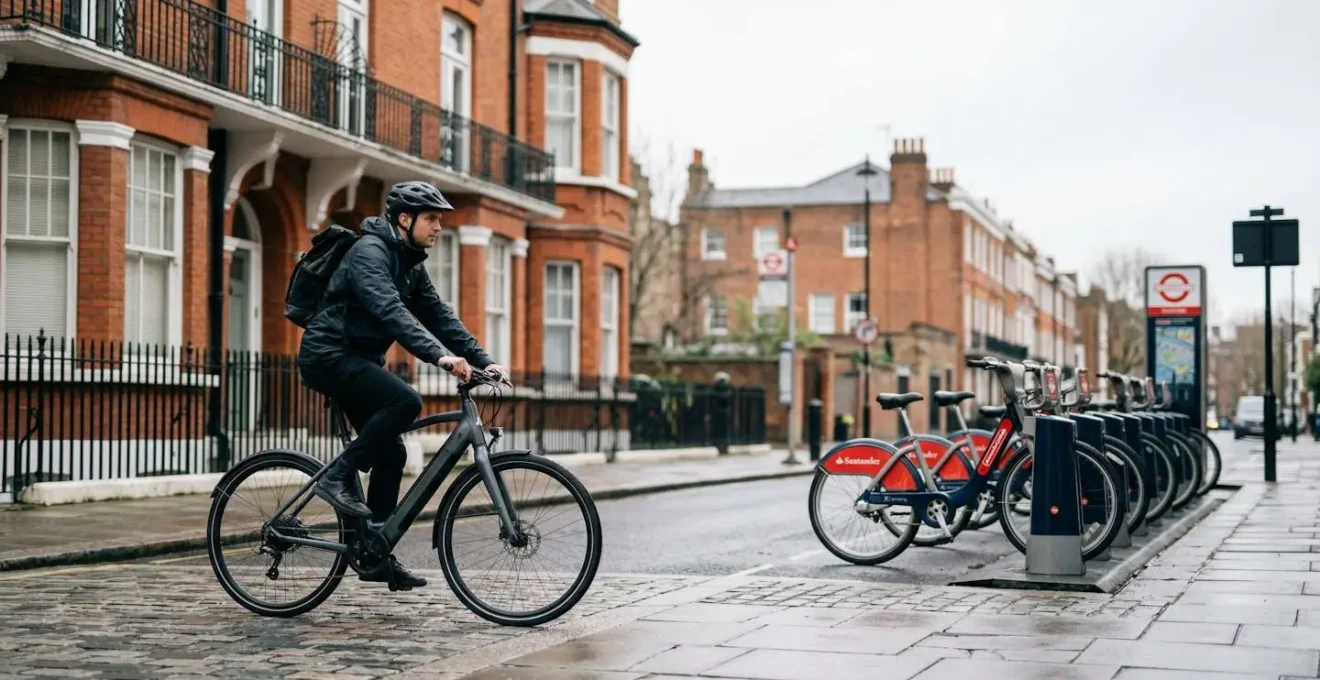
The best cycling choice for a Londoner isn’t about cost, but about which set of urban risks you’re more willing to manage.
- Owning an e-bike offers ultimate freedom but saddles you with the significant burdens of theft prevention and critical fire safety responsibilities.
- Renting a Santander Cycle eliminates these stresses but makes you dependent on the scheme’s availability, pricing, and performance in poor weather.
Recommendation: Assess your personal risk tolerance, daily route, and home storage situation before committing financially. The “cheaper” option may not be the “best” one for your peace of mind.
The daily London commute is a tactical battle. Every morning, thousands of us weigh up the pros and cons of the Tube, the bus, or taking to the streets on two wheels. The rise of micro-mobility has presented a new dilemma: invest in a personal e-bike for ultimate freedom, or rely on the convenience of the ubiquitous Santander Cycles scheme? The debate often boils down to a simple comparison of cost and convenience. But this surface-level analysis misses the point entirely.
For a true Londoner, the decision is far more complex. It’s a strategic trade-off of risks, responsibilities, and realities specific to navigating this sprawling metropolis. The convenience of grabbing any red bike you see is balanced against the frustration of finding an empty docking station. The freedom of a personal e-bike is weighed against the constant, gnawing anxiety of it being stolen or, worse, its battery becoming a fire hazard in your flat.
This guide moves beyond the platitudes. We will not just compare prices; we will dissect the ownership burden. We will not just talk about convenience; we will explore what it truly means to develop “infrastructure literacy” to navigate London’s streets safely. This is not about which option is universally “better,” but which set of challenges you are better equipped to handle. By understanding the hidden complexities—from theft statistics to fire brigade warnings—you can make a decision that genuinely improves your commute and your peace of mind.
To help you navigate this choice, this article breaks down the key practical considerations every London commuter must face. From the real risk of theft to the hidden dangers of charging, we’ll equip you with the knowledge to decide which two-wheeled solution truly fits your lifestyle.
Table of Contents : A Practical Guide to Choosing Your London Commuting Bike
- Why 1 in 5 personal bikes get stolen and how rental schemes eliminate this stress?
- How to use mapping apps to find “Quietways” and avoid heavy HGV traffic?
- Monthly Pass or PAYG: Which works out cheaper for a 15-minute daily ride?
- The charging mistake that makes cheap imported e-bikes a fire hazard in flats
- When to switch back to the bus: The weather conditions that make shared bikes dangerous?
- Bus lanes or Cycle tracks: Which infrastructure investment moves more people per hour?
- How to petition your local council to install a secure bike hangar on your street?
- On-Street Hangers vs Car Parks: Where is the Safest Place to Store Your Bike?
Why 1 in 5 personal bikes get stolen and how rental schemes eliminate this stress?
The single greatest argument against personal bike ownership in London isn’t the cost or the maintenance; it’s the pervasive, soul-crushing risk of theft. This isn’t just an inconvenience; it’s a constant mental burden. Every time you lock your bike up, a small part of you wonders if it will be there when you return. This anxiety is well-founded. In boroughs like Hackney, police data shows a rate of 4.8 bike thefts per 1,000 residents, the highest in the capital.
To combat this, owners invest in heavy, expensive locks, but even these are often no match for a determined thief with an angle grinder. The grim reality is that your expensive e-bike is a high-value target. The emotional and financial toll is compounded by the fact that recovery is almost unheard of. Figures reveal that only around 1% of London bike thefts result in any positive police action like an arrest or conviction. Essentially, once it’s gone, it’s gone for good.
This is where rental schemes like Santander Cycles offer their most compelling benefit: the complete elimination of theft anxiety. The responsibility is not yours. You ride the bike from one docking station to another, and the moment it’s securely docked, your part is done. There is no “ownership burden”—no need to carry a two-kilo lock, no searching for a secure railing, and no sinking feeling when you return to an empty space. For many commuters, trading the freedom of ownership for this peace of mind is the most valuable transaction of all.
How to use mapping apps to find “Quietways” and avoid heavy HGV traffic?
Choosing to cycle in London isn’t just about having a bike; it’s about knowing how to navigate the city’s complex and often intimidating road network. A common mistake for new cyclists is to simply follow the routes designed for cars, placing them in direct conflict with buses, lorries, and impatient drivers. True urban cycling proficiency—what we can call “infrastructure literacy”—means actively seeking out safer, more pleasant routes.
Standard mapping apps are getting better, but to truly master your commute, you need to leverage London-specific resources. The key is to find the network of “Quietways” and segregated cycle tracks. These are routes that run on lower-traffic backstreets or are physically separated from motor vehicles, drastically reducing encounters with heavy goods vehicles (HGVs), which are disproportionately involved in serious cycling incidents. They transform the cycling experience from a stressful battle for road space into a genuinely enjoyable journey.
To build this infrastructure literacy, Transport for London (TfL) provides powerful tools that go beyond basic journey planners. Savvy commuters should familiarise themselves with TfL’s open data resources:
- TfL’s Cycling Infrastructure Database (CID): This is the gold standard for route planning. It contains data on over 240,000 pieces of infrastructure, allowing you to see exactly where segregated lanes, cycle tracks, and other facilities exist.
- Visual Inspection: The database includes nearly half a million photographs, enabling you to visually check the quality of a route before you even leave your home.
- Integrated Journey Planners: TfL’s official Journey Planner now uses CID data, showing you the nearest cycle parking and route infrastructure for any proposed journey.
- Third-Party Apps: Many specialised cycling apps (like Citymapper or CycleStreets) tap into this open data to offer routing algorithms that specifically prioritise safety and quiet routes over speed.
Whether you own a bike or rent one, taking ten minutes to plan your route using these tools can be the difference between a nerve-wracking commute and a relaxing one. It’s a skill that pays dividends in both safety and daily well-being.
Monthly Pass or PAYG: Which works out cheaper for a 15-minute daily ride?
For those leaning towards the Santander scheme, the financial question quickly moves from the large-scale “rent vs. buy” to a more granular decision: is it better to Pay As You Go (PAYG) or commit to a monthly or annual pass? The answer depends entirely on the frequency and consistency of your commute. Let’s break down the maths for a typical scenario: a 15-minute ride to and from work on weekdays.
The bottom line is that for any regular commuter, a pass is almost always the more economical choice. A single 30-minute ride costs £1.65. If you commute daily, that’s two trips a day. Assuming 20 working days a month, the PAYG cost would be £1.65 x 2 x 20 = £66 per month. This is more than triple the cost of the £20 monthly pass, which includes unlimited 60-minute rides. The break-even point is around 12 trips per month; if you plan to use the bikes more than three days a week, the monthly pass immediately saves you money.
The pricing structure is designed to reward frequent users while still being accessible for occasional journeys or tourists. The table below, based on the latest TfL pricing, provides a clear overview to help you make the right financial decision. Remember to factor in the e-bike supplement if you plan to use the powered option regularly, as this can alter the calculation.
This financial breakdown, based on TfL’s most recent pricing updates, helps clarify the options.
| Pass Type | Cost | Ride Duration Included | E-bike Supplement | Best For |
|---|---|---|---|---|
| Day Pass | £3.50 | Unlimited 60-minute rides (24h) | £3 per ride | Tourists, occasional users |
| Monthly Pass | £20/month | Unlimited 60-minute rides | £1 per 60 minutes | Regular commuters (13+ trips/month) |
| Annual Pass | £120/year | Unlimited 60-minute rides | £1 per 60 minutes | Daily commuters |
| Single Ride (regular) | £1.65 | 30 minutes | N/A | One-off journeys |
| Single E-bike Ride | £3.00 | 30 minutes | Included | One-off e-bike users |
The charging mistake that makes cheap imported e-bikes a fire hazard in flats
While the risk of theft is well-known, a far more dangerous and often overlooked aspect of the “ownership burden” is the risk of fire from e-bike batteries. This is not a theoretical problem; it’s a growing crisis in London. The London Fire Brigade (LFB) is increasingly being called to devastating fires caused by faulty lithium-ion batteries, particularly those from cheap, uncertified e-bikes and conversion kits bought online. Data shows a terrifying surge, with the LFB responding to more than 407 fires in 2024 involving e-bikes and e-scooters, a four-fold increase since 2020.
The primary cause of these fires is a phenomenon called “thermal runaway,” where a battery cell failure leads to an unstoppable, explosive chain reaction. The critical mistake many owners make is using incorrect, damaged, or uncertified chargers. A charger that isn’t specifically designed for your battery can overcharge it, leading to overheating and ignition. This risk is massively amplified with cheap, imported bikes and batteries that haven’t been subjected to rigorous UK or EU safety standards.
The consequences can be catastrophic, especially in flats and shared accommodation where escape routes can be easily blocked. These fires burn with incredible intensity and release toxic fumes, making them exceptionally dangerous. To mitigate this severe risk, every e-bike owner must adhere to strict safety protocols. The LFB’s #ChargeSafe campaign provides a vital checklist for anyone charging an e-bike at home.
Your #ChargeSafe Action Plan: E-Bike Fire Prevention
- Escape Route: Never store or charge your e-bike in a hallway, corridor, or any part of your home’s escape route.
- Certification Check: Always ensure your battery and charger display the UKCA or CE marks, proving they meet mandatory safety standards.
- Avoid DIY Kits: Do not use online conversion kits. If converting a bike, have it done professionally and only use batteries from reputable sellers. Never buy second-hand batteries.
- Correct Charger: Only ever use the specific charger that came with your battery. Using a generic or different model’s charger is a primary cause of fires.
- Warning Signs: Be vigilant for battery malfunction. If it gets excessively hot, makes unusual smells, looks swollen, or its performance drops, unplug it immediately and take it outside.
When to switch back to the bus: The weather conditions that make shared bikes dangerous?
London’s weather is notoriously fickle, and it’s the single biggest factor that can derail a cycling commute. While a dedicated, all-weather cyclist with the right gear might persevere through a downpour, the reality for most commuters using shared bikes is different. Adverse weather conditions not only make the ride unpleasant but can also make it significantly more dangerous.
The most obvious culprits are rain and ice. Wet roads drastically increase braking distances and reduce visibility. Puddles can hide dangerous potholes, and painted road markings become incredibly slippery. Santander Cycles are heavy, sturdy machines, but their tyres are not designed for optimal grip in icy conditions. During a cold snap, with a risk of black ice, taking to two wheels becomes a high-stakes gamble. High winds, particularly on exposed bridges or wide roads, can also be a serious hazard, making the bike unstable and difficult to control.
Here, the flexibility of not owning a bike is a major advantage. A Santander user can simply look at the forecast and decide to take the bus or Tube, with no sunk cost or abandoned bike to worry about. It’s a pragmatic approach to risk management. However, there’s an interesting and counter-intuitive safety aspect to consider. As Transport for London pointed out in a safety study:
Cyclists using the scheme are three times less likely to be injured per trip than cyclists in London as a whole, possibly due to motorists giving cycle hire users more road space.
– Transport for London, TfL safety study on Santander Cycles
This suggests that the distinctive, bulky nature of a Santander Cycle might make drivers more cautious around them. This “safety in visibility” could partially offset some of the inherent risks, but it doesn’t negate the fundamental physics of a slippery road. The smart commuter knows when to call it a day and switch back to public transport.
Bus lanes or Cycle tracks: Which infrastructure investment moves more people per hour?
The debate between personal e-bikes and rental schemes plays out on a stage built by public policy and infrastructure investment. The quality and availability of dedicated cycling infrastructure directly impacts the safety and viability of either choice. In London, there has been a significant push to reallocate road space to more efficient modes of transport, moving away from a car-centric model.
A common argument against new cycle lanes is that they take space away from cars or buses, causing congestion. However, when measured by the number of people moved per hour, dedicated cycle tracks are remarkably efficient. A single 3-metre-wide protected cycle lane can carry thousands of people per hour, far more than a general traffic lane in a congested urban centre. This increased “people-moving” capacity is why cities are investing heavily in cycling infrastructure; it’s a pragmatic solution to urban congestion.
This investment is paying off. According to TfL data, the expansion of high-quality routes has been rapid. The latest figures show a significant increase in the number of people living near safe cycling paths, with 22% of Londoners now living within 400m of a good cycle route, nearly double the pre-pandemic figure. This ongoing “infrastructural dividend” makes cycling a more attractive option every year. For the individual commuter, this means that routes that were once considered too dangerous may now be accessible via a new cycleway, changing the calculus of the rent-versus-buy decision.
Ultimately, both bus lanes and cycle tracks are more efficient at moving people than private cars. The expansion of the cycle network benefits all cyclists, whether on a personal e-bike or a Santander Cycle, by making the entire system safer and more connected.
How to petition your local council to install a secure bike hangar on your street?
For many potential e-bike owners living in flats or terraced houses, the biggest logistical hurdle is secure overnight storage. Lugging a heavy e-bike up several flights of stairs is impractical, and leaving it locked on the street is an open invitation to thieves. This is where on-street bike hangars—secure, covered units that typically replace a single car parking space—become a game-changer. But what if your street doesn’t have one?
This is where bike ownership can intersect with civic engagement. You have the power to request one. Every London borough council has a process for residents to request new bike hangars. While the exact procedure varies, it generally involves demonstrating local demand. You can’t just send an email; you need to show that you and your neighbours want and will use the facility.
The first step is to visit your local council’s website and search for “bike hangars” or “cycle parking.” You will likely find a dedicated page with a form or an expression of interest to fill out. The key to a successful application is to gather support from your immediate neighbours. Talk to people on your street, especially those who already cycle or have expressed an interest. Most councils will prioritise locations where they can fill a hangar (which typically holds six bikes) quickly. A petition or a list of interested residents can significantly strengthen your case.
This may seem like a long shot, but your request aligns with city-wide policy. TfL’s Cycle Parking Implementation Plan includes a commitment to deliver 50,000 new cycle parking spaces, with a focus on residential areas where demand is high. By petitioning your council, you are not just asking for a personal favour; you are helping them meet their strategic targets for promoting active travel. It’s a proactive step that is a fundamental part of the responsibility of bike ownership in a dense urban environment.
Key Takeaways
- The core decision is a “risk trade-off”: the theft and fire risk of ownership versus the availability and weather dependency of renting.
- For regular commuters, a Santander monthly pass is significantly cheaper than paying per ride.
- E-bike ownership comes with a non-negotiable duty of care regarding battery safety to prevent devastating fires.
- Leveraging London-specific tools like the Cycling Infrastructure Database to find “Quietways” is crucial for a safer commute on any bike.
On-Street Hangers vs Car Parks: Where is the Safest Place to Store Your Bike?
Once you’ve decided to take the plunge into e-bike ownership, the question of secure storage becomes paramount. Simply locking your bike to a lamppost overnight is not a viable long-term strategy in London. The options generally come down to a few key choices, each with its own level of security and cost: on-street bike hangars, dedicated secure car parks, or storage within your own property.
For those without space at home, on-street hangars are the gold standard. They provide a high level of security, protecting bikes from both theft and the elements within a locked, robust container. While not impenetrable, they are a massive deterrent compared to a simple lock on the street. The main drawback is availability and cost; there are often long waiting lists, and spaces come with an annual rental fee.
Some commuters might consider using secure commercial or residential car parks. While these offer shelter and are often monitored by CCTV, their security for bikes can be variable. A bike parking rail in a corner of a public car park may not be as secure as a dedicated hangar, and access can be less convenient. The best option is a dedicated, access-controlled cycle hub within a larger facility, often found at major transport interchanges.
Ultimately, the safest place is always within your own home, but this is often the least practical. The key is to create as many layers of security as possible, wherever you store it. This includes using two different types of high-quality locks (e.g., a D-lock and a heavy chain), registering your bike, and ensuring your home or contents insurance specifically covers your bike for its full value, both at home and away from it.
Ultimately, the best choice is the one that aligns with your personal risk profile, budget, and daily reality. Before you buy or subscribe, spend a week mapping your potential routes, assessing your home’s storage options, and honestly evaluating which set of stresses—the constant vigilance of ownership or the daily dependency of renting—you are better equipped to handle.