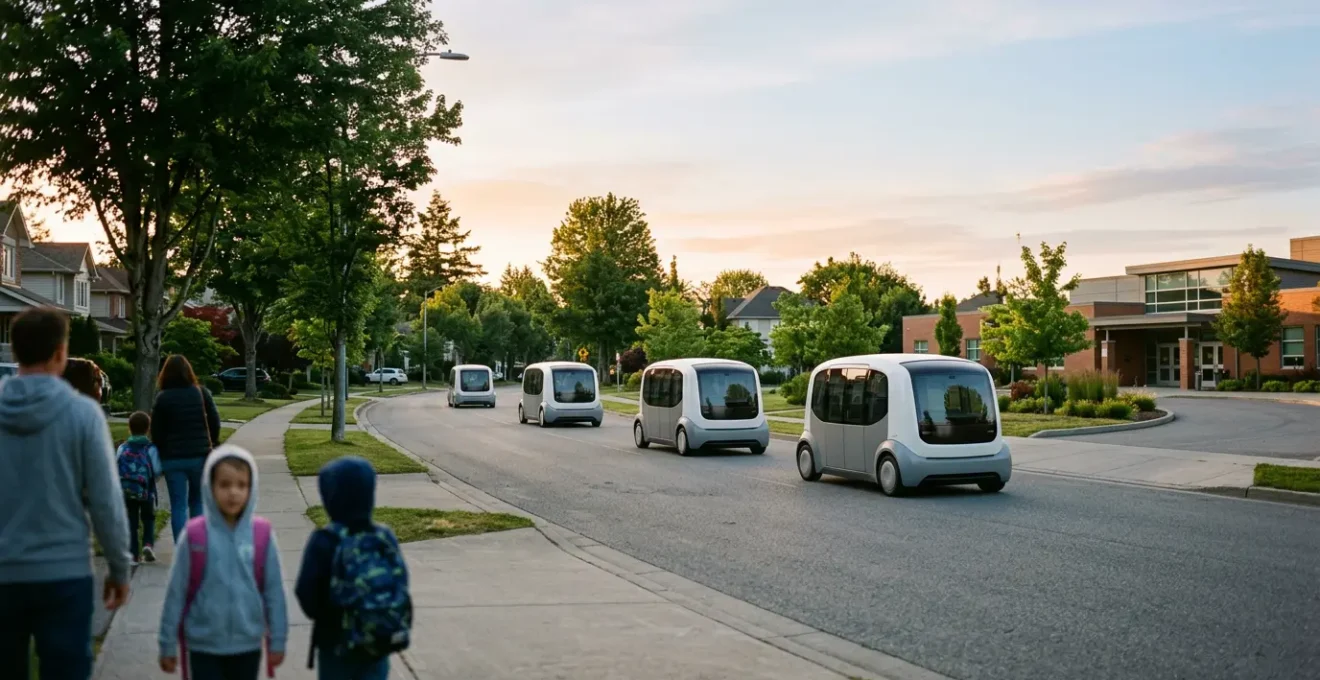
The conversation about autonomous school transport isn’t about traffic flow; it’s a domestic revolution that redefines the threshold of our homes and the nature of parental supervision.
- Public fear of AVs stems from a psychological “perception gap,” not a lack of safety, requiring a shift in how we trust algorithms.
- The biggest challenge isn’t the road but the “last metre,” requiring new home infrastructure for vehicle docking and security.
- The interior of an autonomous pod becomes a “contained digital environment,” making digital boundaries as crucial as physical seatbelts.
Recommendation: Planners and parents must shift their focus from public roads to private driveways and from vehicle safety to the challenge of “algorithmic guardianship.”
The vision of the future school run often splits into two camps: fleets of efficient, shared shuttles optimising routes, or personalised, private pods delivering children to their doorsteps on demand. While we debate the merits of shared versus private transit, we are missing the fundamental transformation at play. This isn’t just about replacing the school bus or the family car. The arrival of autonomous transport at our curb is the harbinger of a profound domestic revolution, challenging our concepts of safety, home, and even parenting itself.
The core of this shift lies in a concept we can call algorithmic guardianship. For the first time, we are being asked to delegate the care of our children not to another human, but to a complex system of software and sensors. This leap of faith triggers deep-seated anxieties that go far beyond statistics on accident rates. It forces us to ask new questions: not just “Is the vehicle safe on the road?” but “Is my home prepared for its arrival?” and “How do I parent my child inside a moving, connected space I cannot see or control directly?”
The true challenge is not engineering a vehicle that can navigate a street, but preparing our society for a technology that crosses the domestic threshold. It’s a change that begins with our perception of risk and extends all the way to the physical layout of our driveways and the digital rules we set within our families. This guide explores this new reality, moving beyond the vehicle to examine the infrastructure, insurance, and supervision frameworks we must build to navigate it safely.
To fully grasp the implications of this change, this article breaks down the key challenges and opportunities, from the psychology of fear to the practicalities of screen time. The following sections will guide you through this new landscape.
Summary: The New Rules of the Autonomous School Run
- Why 60% of people fear driverless pods despite them being safer than human drivers?
- How to adapt your private road or driveway for future autonomous deliveries?
- Lidar or Cameras: Which technology is more reliable for shuttles in foggy UK weather?
- The insurance grey area: Who pays if a driverless shuttle hits a parked car?
- When will it be normal: The timeline for autonomous shuttles replacing local bus routes?
- Why closing side roads to cars actually increases footfall for local high streets?
- The supervision mistake that leaves your child exposed to toxic gaming lobbies
- How to Implement Screen Time Boundaries for Kids Without Causing a Family War?
Why 60% of people fear driverless pods despite them being safer than human drivers?
The persistent fear of autonomous vehicles is one of the greatest paradoxes in modern transport. While data consistently points towards a future where automated systems drastically reduce accidents caused by human error, a significant portion of the public remains deeply sceptical. A recent survey highlights this, showing that 61% of U.S. drivers report being afraid to ride in a self-driving vehicle. This phenomenon is not rooted in statistics, but in a psychological concept: the perception gap between objective safety and subjective feeling of control.
Human beings are wired to feel safer when they are in command, even if their control is statistically more dangerous. Relinquishing the wheel to an invisible algorithm triggers a primal sense of vulnerability. We can understand the logic of an AI, but we cannot intuitively feel its intentions or anticipate its “reflexes” like we would with a human driver. This loss of perceived agency is the primary driver of fear. The anxiety is less about the technology failing and more about our inability to intervene if it does.
Furthermore, media coverage tends to amplify rare autonomous vehicle accidents, while the millions of daily incidents caused by human drivers go largely unreported, skewing public perception. As Greg Brannon, AAA’s Director of Automotive Engineering, notes, the focus for building trust should be on the tangible safety benefits for the passenger. He states:
Most drivers want automakers to focus on advanced safety technology. Though opinions on fully self-driving cars vary widely, it’s evident that today’s drivers value features that enhance their safety.
– Greg Brannon, AAA Automotive Engineering Director
Overcoming this fear will require more than just proving the technology’s reliability. It will demand transparent communication, educational initiatives that demystify how the AI makes decisions, and systems that provide passengers with a clear sense of oversight and emergency control, even if it’s rarely, if ever, needed.
How to adapt your private road or driveway for future autonomous deliveries?
The autonomous revolution doesn’t stop at the public kerb; it crosses the domestic threshold and comes right up to our front doors. Preparing for this requires us to stop thinking about a “driveway” and start envisioning a “docking station.” The challenge is no longer about just parking a car, but about creating a seamless, secure interface for a sophisticated machine. This is the new field of last-metre infrastructure, and it will become a standard feature of future homes.
A smart driveway or private road will need to facilitate three core functions: guidance, power, and security. Firstly, the vehicle will require clear, unambiguous markers for its final approach. This could involve embedded RFID tags, painted QR-style codes, or low-power Bluetooth beacons that provide high-precision positioning for a perfect stop. This ensures the pod aligns correctly for safe disembarking and for its charging and data-transfer connections.
This leads to the second function: automated power transfer. For a truly autonomous system, the vehicle must manage its own energy needs. Driveways will be equipped with wireless induction charging pads, allowing the pod to recharge automatically while waiting. This eliminates the need for manual plugging and ensures the fleet remains operational without human intervention. The same connection point could also facilitate high-speed data transfer for software updates and diagnostics.
Finally, security is paramount. The docking station must be able to authenticate the vehicle to prevent unauthorised pods from accessing the property. This handshake protocol would confirm the vehicle’s identity before it’s allowed to drop off a passenger or package, integrating the pod into the home’s broader smart security system. The illustration below captures a close-up of how this embedded technology might look.
As you can see, the design is subtle and integrated. It’s not a factory-like installation, but a sleek and weatherproof part of the home’s landscape. Planning for these adaptations now will ensure a smooth and secure transition when autonomous services become the norm.
Action Plan: Auditing Your Driveway for Autonomous Readiness
- Points of Contact: List all potential drop-off and pick-up zones on your property. Identify the safest, most accessible spot for a child to disembark, protected from other traffic.
- Surface & Clearance Assessment: Check the driveway surface. Is it level and clear of obstacles? Inventory any overhead obstructions (branches, cables) or tight turns that could confuse a vehicle’s sensors.
- Power & Data Proximity: Identify the nearest outdoor power source. Could a dedicated circuit be run to the proposed docking spot for future installation of a wireless charging pad? Assess Wi-Fi signal strength at that location.
- Integration with Home Security: Review your current security system (cameras, gate controls). Does it have the capacity to integrate with a third-party API for vehicle authentication? Identify where a new camera might be needed to monitor the docking zone.
- Phased Upgrade Plan: Create a prioritised list of upgrades. Start with simple changes (clearing obstructions, improving lighting) and create a long-term plan for more complex installations like charging pads and sensor markers.
Lidar or Cameras: Which technology is more reliable for shuttles in foggy UK weather?
For autonomous shuttles to gain public trust, especially for the school run, they must demonstrate flawless performance in all conditions. In a climate like the UK’s, characterised by frequent rain, mist, and fog, the choice of primary sensor technology is not just a technical detail—it’s a critical safety decision. The debate largely centres on two technologies: cameras, which mimic human sight, and Lidar (Light Detection and Ranging), which uses lasers to build a 3D map of the world.
While cameras are inexpensive and excellent at interpreting signs, traffic lights, and road markings, they share a fundamental weakness with the human eye: they struggle in poor visibility. Heavy fog, torrential rain, or the glare of a low sun can blind a camera, rendering it unreliable precisely when driving conditions are most dangerous. This is where Lidar’s inherent advantages become clear. By emitting its own light in the form of laser pulses, Lidar is not dependent on ambient light and can “see” through particulates that would obscure a camera’s vision.
In fact, research from the University of Minnesota found that Lidar technology can see better and further in fog than camera systems or even human eyes. Lidar systems operating on specific infrared wavelengths (like 1550 nm) are particularly effective, as these light waves are absorbed far less by water vapor than visible light. This gives the vehicle a crucial advantage, allowing it to detect an obstacle or a pedestrian far sooner than a camera-based system could in a thick morning fog.
Real-world tests confirm this superiority. In a study comparing sensor performance in the rain, sensor company Ouster found that while a single water droplet could obscure a huge portion of a camera’s view, their Lidar sensor was largely unaffected. The system’s larger optical aperture allowed light to pass around water beads, and its software effectively filtered out the “noise” from falling raindrops, maintaining a clear and accurate 3D image of the environment. For the reliable, all-weather operation demanded by a service like the school run in the UK, a sensor fusion approach is necessary, but Lidar must serve as the foundational layer for its unmatched performance in adverse conditions.
The insurance grey area: Who pays if a driverless shuttle hits a parked car?
The shift to autonomous vehicles fundamentally rewrites the rules of liability. For over a century, auto insurance has been built on a simple premise: pricing the risk of human error. When a driverless shuttle is involved in an incident, the human is removed from the equation, leaving a complex web of responsibility between the owner, the operator, and the manufacturer of the vehicle and its software. This “grey area” is the single biggest hurdle for the insurance industry, but regulators are already building a new framework.
The emerging consensus is a move towards a form of product liability. If the vehicle’s decision-making algorithm is at fault, the responsibility will likely fall on the manufacturer or the software developer. If a sensor fails due to poor maintenance, the fleet operator could be liable. This changes everything. Insurers are no longer assessing the driving habits of millions of individuals; they are now tasked with evaluating the quality and reliability of a handful of complex “algorithmic drivers” developed by tech companies and automakers.
Jurisdictions are already putting this into practice. For example, to operate autonomous vehicles, California mandates that AV operators carry a minimum of $5 million in liability coverage. This high figure reflects the understanding that a single software flaw could theoretically cause a systemic failure across an entire fleet, leading to claims far exceeding a typical personal auto policy. This creates a powerful financial incentive for manufacturers to ensure their systems are as close to flawless as possible.
Ultimately, a hybrid model will likely emerge. The fleet operator will hold a primary commercial insurance policy, similar to those held by taxi or bus companies today. However, this policy will be priced based on the vehicle’s certified safety level, its operational domain (the specific areas and conditions it’s approved for), and the historical performance of its AI. For parents using these services, this means their personal car insurance will be irrelevant. They are entrusting their child to a commercially insured service, and in the event of an incident, the claim will be a complex negotiation between corporate insurers, not individuals.
When will it be normal: The timeline for autonomous shuttles replacing local bus routes?
Predicting the exact date when autonomous shuttles become a commonplace sight is challenging, but the transition from niche trials to widespread adoption is already underway. Rather than a single “flip the switch” moment, we are seeing a phased rollout, starting in controlled environments and gradually expanding. The technology for Level 4 autonomy (where a vehicle operates without a driver in a specific, geofenced area) is largely mature. The primary barriers are now regulatory approval, public acceptance, and economic scalability.
The most realistic timeline suggests that we will see autonomous shuttles replacing specific, low-speed, and predictable routes within the next 3 to 5 years. Think of university campuses, large corporate parks, retirement communities, and dedicated airport transit loops. These are ideal testbeds because they have controlled traffic, clear routes, and a high-density of users. The school run, particularly in suburban areas with less predictable traffic, represents a more complex challenge and will likely follow in a second wave, perhaps in the 5 to 10-year timeframe.
This is not speculation; large-scale projects are already proving the model’s viability in complex urban environments.
Case Study: The EU SHOW Project
The SHOW (SHared automation Operating models for Worldwide adoption) Project is a massive European Union initiative that has deployed over 80 SAE Level 4/5 autonomous vehicles across 20 cities. These shuttles serve both passengers and cargo in mixed traffic and dedicated lanes. Data gathered from real-world operations in six pilot cities demonstrated remarkable reliability. For instance, the system’s arrival time predictions for passengers had a maximum error of just 60 seconds for journeys up to five stops ahead. While the shuttles currently operate at reduced speeds under strict regulatory oversight, the project proves that the technology is capable of integrating safely and efficiently into the fabric of a modern city.
The success of projects like SHOW provides a clear roadmap. As regulators become more comfortable with the safety data and cities see the benefits in reduced congestion and pollution, the pace of adoption will accelerate. The replacement of local bus routes will begin with the least complex ones and expand as the technology and the public’s confidence grow in tandem.
Why closing side roads to cars actually increases footfall for local high streets?
The rise of autonomous shuttles and on-demand pods promises a future with fewer privately owned cars clogging city streets. This opens up a transformative opportunity for urban planners: reclaiming road space for people. The concept of pedestrianising side roads around commercial centres is often met with resistance from retailers who fear that cutting off car access will kill their business. However, decades of urban planning data show the exact opposite is true: reducing car traffic directly and significantly increases footfall and commercial activity.
The logic is simple. When a street is dominated by cars—with their noise, pollution, and physical danger—it becomes a “through space,” a place to pass through as quickly as possible. It is not a “destination space” where people want to linger, browse, or socialise. By removing vehicles, you transform the street’s character. It becomes safer, quieter, and more pleasant. This encourages a different kind of behaviour. People slow down, they walk more, they notice shop windows, and they are more likely to make impulse purchases.
Imagine a typical high street. With cars, a family might drive to one specific shop, park, complete their errand, and leave. The car acts as a barrier to further exploration. When that same family arrives via a shuttle that drops them at the end of a pedestrianised zone, their entire mindset changes. The journey itself becomes part of the experience. They might stroll down the street, stop for a coffee, let their children run safely, and visit multiple stores instead of just one. The dwell time—the amount of time a potential customer spends in an area—skyrockets, and dwell time is directly correlated with spending.
This is not a theoretical ideal; it’s a proven model from London to New York. By creating these “low-traffic neighbourhoods,” cities don’t just improve air quality and safety; they create a more robust and resilient local economy. Autonomous transport is the catalyst that can make this vision a widespread reality, turning our noisy, car-choked high streets back into thriving community hubs.
The supervision mistake that leaves your child exposed to toxic gaming lobbies
As we hand over the physical safety of our children to an autonomous pod, a new and more insidious risk emerges: the unmonitored digital space within it. The journey to and from school becomes a new frontier for screen time. The critical mistake is to view this time as equivalent to watching a movie in the back of a car. It’s not. The pod is a contained digital environment, an isolated bubble where a child has uninterrupted, unobserved access to the internet. This creates the perfect conditions for exposure to harmful content, particularly in the world of online gaming.
Parents may feel a false sense of security, believing their child is simply playing a game. But many modern games are built around public voice and text chat lobbies—unmoderated social spaces where bullying, toxic language, and exposure to adult themes are rampant. A child sitting alone in a pod, wearing headphones, is completely vulnerable. There is no parent in the front seat to overhear a suspicious conversation or glance back to see what’s on the screen. This is the new form of parental blindness, a product of algorithmic guardianship.
The image below captures this isolated immersion. The child is not just a passenger; they are absorbed in an interactive world, a space where the rules of the physical world no longer apply and parental oversight is absent.
The solution is not to ban screens, which is an unrealistic goal. The solution is to extend our parenting into this new digital space. This means treating the pod’s entertainment system with the same diligence as a home computer or tablet. It requires setting up robust parental controls before the journey even begins, curating the content available, and, most importantly, disabling access to open, unmoderated communication channels. We must pre-emptively build a digital “walled garden” inside the pod to ensure the journey is as safe digitally as it is physically.
Ignoring this digital dimension is the biggest supervision mistake a parent can make in the age of autonomous transport. The responsibility for safety doesn’t end when the pod’s door closes; it simply shifts from the physical to the digital realm.
Key Takeaways
- The primary barrier to AV adoption is psychological fear due to a perceived loss of control, not technological capability.
- Future-proofing homes for AVs means creating “docking stations” with guidance, power, and security, a concept known as “last-metre infrastructure.”
- In the context of a solo journey, the pod’s interior becomes a “contained digital environment” where digital safety is as important as physical safety.
How to Implement Screen Time Boundaries for Kids Without Causing a Family War?
Implementing screen time rules inside an autonomous pod presents a unique challenge: enforcement without presence. When you’re not physically there to say “time’s up,” the boundaries must be built into the technology itself. The key to avoiding conflict is to frame these rules not as punishments, but as a collaborative agreement that ensures a healthy and balanced digital experience during the commute. The goal is to move from being a “monitor” to being a “planner.”
The first step is the pre-journey agreement. Before the first ride, sit down with your child and discuss the purpose of screen time in the pod. Is it for education, entertainment, or winding down? Together, create a simple “commute charter.” This could include rules like: “On the way to school, we use learning apps. On the way home, we can have 20 minutes of game time, then switch to an audiobook.” Involving the child in setting the rules gives them a sense of ownership and makes them more likely to comply.
Secondly, leverage technology to be the “bad guy.” Use the parental controls within the pod’s operating system or third-party apps to automate the limits you’ve agreed upon. Set timers that automatically close an app after the allotted time. Create content filters that only allow access to age-appropriate games and videos. When the system enforces the rule, it depersonalises the conflict. It’s no longer you saying “no”; it’s the system following the pre-agreed plan. This is a practical application of algorithmic guardianship, where you configure the rules for the AI to enforce on your behalf.
Finally, provide compelling alternatives. The “war” over screen time often happens because the alternative is boredom. Ensure the pod is stocked with non-digital options. This could be a collection of audiobooks, podcasts, or even old-fashioned physical books and drawing materials. By making the “off-screen” time just as engaging, you’re not just taking something away; you’re offering something equally valuable. This transforms the commute from a potential battleground into a space for varied and healthy engagement.
As we stand on the cusp of this transport revolution, the focus must shift. Preparing for the autonomous school run requires more than just trusting the technology; it requires us to actively plan our domestic and digital infrastructure. By anticipating these changes, you can ensure your family is ready to embrace the future of mobility safely and confidently. Evaluate the solutions that can help you manage this new reality today.