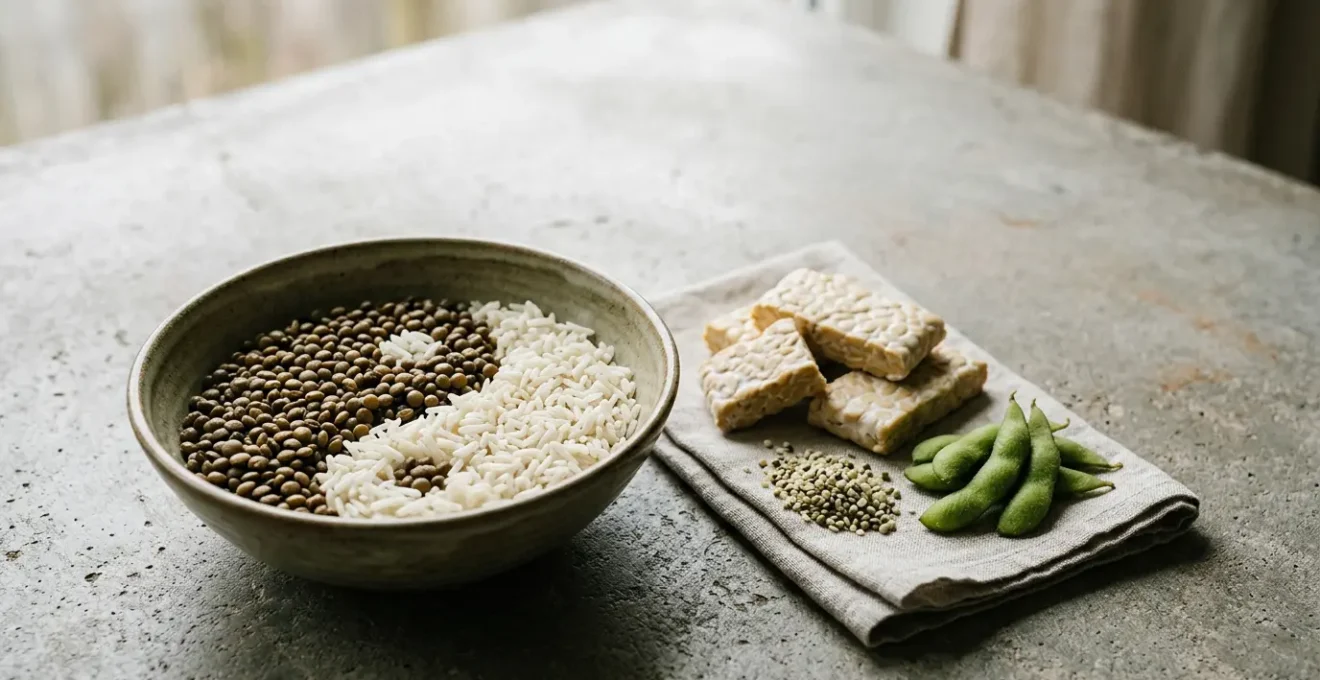
The secret to effective vegan protein isn’t combining foods at every meal; it’s maximising amino acid bioavailability through smart preparation and timing.
- Your body maintains an amino acid “pool,” making total daily protein intake more critical than same-meal combinations for muscle repair.
- How you cook plant proteins (e.g., steaming tempeh, simmering seitan) dramatically impacts their texture, flavour, and your body’s ability to use them.
Recommendation: Shift your focus from what to combine to how to prepare. Start by mastering one technique, like steaming tempeh, to unlock its full nutritional potential.
For many new vegans and flexitarians in the UK, the question of protein is a primary concern. You’ve made a conscious choice for your health, the planet, or animal welfare, but the nagging doubt remains: “Am I getting enough? Is it the *right kind* of protein?” You’ve probably heard the classic advice to combine rice and beans, a well-intentioned but often misunderstood guideline that leaves many feeling restricted and confused. This leads to a reliance on the same few meals or, worse, a cabinet full of ultra-processed “vegan” products that promise much but deliver little.
The anxiety around “complete proteins”—those containing all nine essential amino acids—is valid, but the conventional wisdom is outdated. The focus on meticulous food combining at every single meal is a myth that has been largely debunked. Your body is smarter than that; it maintains a daily “pool” of amino acids it can draw from to build complete proteins as needed. This simple shift in understanding opens up a world of possibilities and frees you from nutritional micromanagement.
But if the key isn’t just combining, what is it? The real leverage for building a strong, resilient body on a plant-based diet lies in two often-overlooked areas: bioavailability and texture. It’s about choosing high-quality sources and preparing them in a way that unlocks their full nutritional potential and makes them genuinely delicious to eat. This guide, written from the perspective of a plant-based sports nutritionist, will move beyond the myths to give you practical, science-backed strategies to ensure your protein intake is not just adequate, but optimal for muscle repair, energy, and long-term health.
This article will provide a clear, actionable playbook for mastering plant-based protein. We will deconstruct common protein sources, explore preparation techniques that transform their nutritional value, and provide specific strategies for fuelling athletic performance. The following sections will guide you step-by-step through this new approach.
Summary: The Complete Guide to Vegan Protein for Performance
- Why eating only lentils without rice leaves your muscle repair capability incomplete?
- How to prepare tempeh so it actually tastes good and absorbs marinade?
- Seitan or Pea Protein: Which creates a better texture for homemade meat alternatives?
- The nutritional trap of “vegan nuggets” that contain less protein than bread
- When to drink your shake: The anabolic window reality for plant-based athletes?
- Why blending lentils into bolognese sauce boosts fibre without the kids noticing?
- How to calculate exactly how many grams of potato you need for a 2-hour run?
- Carb-Loading for a Half-Marathon: Why Pasta Isn’t Always the Best Choice?
Why eating only lentils without rice leaves your muscle repair capability incomplete?
The idea that you must eat lentils and rice in the same mouthful to form a “complete protein” is one of the most persistent myths in plant-based nutrition. While it’s true that most plant foods are lower in one or more essential amino acids (EAAs), the body doesn’t require them all at once. It maintains a reservoir of amino acids, often called the “amino acid pool,” that it can draw from throughout the day. This means eating rice at lunch and lentils for dinner is perfectly effective for muscle protein synthesis.
However, the concept of “incomplete” protein isn’t entirely without merit; it just points to a more nuanced issue: bioavailability. Not all protein you consume is absorbed and used equally. Lentils, for example, are a powerhouse of nutrition but are relatively low in the essential amino acid methionine. Furthermore, their protein isn’t fully accessible. A 2022 study using isotope tracking found that about 69% of the methionine in raw lentils is metabolically available, a figure that can be influenced by cooking and preparation. While your body can compensate by drawing from its pool, consistently relying on a single, low-methionine source without complementing it with methionine-rich foods (like grains, nuts, and seeds) over the course of your day can create a bottleneck in muscle repair processes.
Therefore, the goal isn’t rigid combining, but a balanced daily intake. Think of your diet over a 24-hour period. By ensuring a variety of protein sources—legumes, grains, nuts, seeds, and soy products—you provide your body with a steady supply of all nine EAAs to keep your amino acid pool topped up and ready for repair and growth. It’s a more flexible and scientifically accurate approach to plant-based eating.
How to prepare tempeh so it actually tastes good and absorbs marinade?
Tempeh is a nutritional champion in the plant-based world, packed with protein, prebiotics, and minerals. Yet for many, the first experience is a disappointment. It can be bitter, dense, and stubbornly resistant to flavour. This isn’t a flaw in the tempeh, but a failure of preparation. The secret to transforming this fermented soybean cake from a bland block into a flavour sponge is a simple, non-negotiable step: steaming.
The dense structure of tempeh, formed by the mycelium that binds the soybeans, is what makes it so firm. Steaming it for just 10-15 minutes accomplishes two crucial things. First, it neutralises the slightly bitter flavour that can be off-putting. Second, and more importantly, it opens up the porous structure of the tempeh, making it incredibly absorbent. A block of raw tempeh is like a dry, compact sponge; a block of steamed tempeh is a damp, expanded sponge, ready to soak up any marinade you introduce.
This textural transformation is where the magic happens. After steaming and cooling, the tempeh will greedily absorb a well-balanced marinade containing acid (like lime juice), salt (like tamari or soy sauce), fat (like sesame oil), and umami (like miso paste). This process infuses flavour deep into its core, rather than just coating the surface. The image below illustrates how the texture changes, becoming ready for flavour absorption.
Once marinated, the possibilities are endless. Thinly sliced and pan-fried, it becomes crispy and chewy, a perfect substitute for bacon. Crumbled and sautéed, it mimics the texture of ground meat in tacos or sauces. Cubed and baked, it offers a firm, satisfying bite for salads and grain bowls. By mastering this one simple preparation step, you unlock the true culinary and nutritional potential of tempeh.
Seitan or Pea Protein: Which creates a better texture for homemade meat alternatives?
When making meat alternatives from scratch, the choice between seitan (vital wheat gluten) and pea protein isolate is a crucial one that dictates the final texture of your dish. There is no single “better” option; instead, each excels in creating a specific and distinct mouthfeel. Understanding their fundamental properties is key to achieving your desired result, whether it’s a “pulled pork” or a “burger patty.”
Seitan is pure gluten, the protein found in wheat. Its power lies in its ability to form long, elastic strands when kneaded and cooked. This creates a uniquely stringy, shreddable, and chewy fibrous structure that is remarkably similar to muscle tissue. This makes it the undisputed champion for recipes where a “meaty” tear-apart quality is desired, such as steak strips, deli slices, roasts, or pulled preparations. It requires simmering in a flavourful broth to both cook the gluten and infuse it with taste, as its natural flavour is quite mild and wheaty.
Pea protein isolate, on the other hand, behaves very differently. It doesn’t form fibrous strands. Instead, it creates a dense, bouncy, and uniform gel-like texture when mixed with water and binders. This makes it ideal for homogenous products like burgers, meatballs, and nuggets, where a firm, consistent bite is more important than a stringy texture. However, as noted by experts, it can be challenging. According to B. Pam Ismail of the Plant Protein Innovation Center, pure “pea and chickpea proteins form a relatively weak gel, making the end product loose and stodgy” without modification or the right binders. It requires careful moisture management and the addition of fats and umami-rich seasonings to achieve a satisfying result.
This table from an analysis of plant protein structures provides a clear comparison for your kitchen experiments:
| Characteristic | Seitan (Vital Wheat Gluten) | Pea Protein Isolate |
|---|---|---|
| Texture Profile | Stringy, shreddable, chewy fibrous structure | Dense, bouncy, uniform gel-like texture |
| Protein Content | 75g per 100g (25g per 3.5oz serving) | 85-90% protein concentration |
| Best Applications | Pulled preparations, steak strips, sausages, cutlets | Burgers, meatballs, nuggets, dense patties |
| Flavor Base | Mild wheaty taste; requires flavorful cooking broth | Neutral to slightly chalky; needs fat and umami boosters |
| Preparation Method | Knead, simmer in broth with mushroom, onion, soy sauce | Mix with binders and seasonings; requires moisture management |
| Dietary Considerations | Not gluten-free; unsuitable for celiac disease | Gluten-free, allergen-friendly, soy-free option |
The nutritional trap of “vegan nuggets” that contain less protein than bread
The rapid growth of the plant-based market has flooded supermarket aisles with convenient, ready-to-eat meat alternatives. While this is great for accessibility, it has created a nutritional minefield. Many ultra-processed products, like some “vegan nuggets” or “plant-based goujons,” are marketed as high-protein options but are often composed primarily of starches, fillers, and fats, with minimal actual protein. It’s not uncommon to find products where the protein content per 100g is lower than that of a simple slice of wholemeal bread.
This is the nutritional trap: you believe you’re consuming a protein-centric food, but you’re actually getting a calorie-dense, nutrient-poor substitute. The key to avoiding this is to become a savvy label-reader. The ingredients list is your first clue; the primary protein source (e.g., soy protein, pea protein) should be one of the first two ingredients, not buried after water, flour, and oils. The second step is to look at the nutritional panel and assess the protein density.
A simple rule of thumb is to look for products with at least 15g of protein per serving. A more advanced technique is to calculate the Protein Density Score (PDS): divide the grams of protein by the total calories, then multiply by 10. A score of 4 or higher indicates a genuinely protein-dense food. In contrast, high-quality isolates used in better products have a protein concentration of 85-90% before being mixed with other ingredients. By using the following audit, you can systematically evaluate the quality of your protein choices and make more informed decisions.
Your 5-Point Vegan Protein Audit
- Source Inventory: List all primary protein sources you consume in a typical week (e.g., specific brands of tofu, lentils, powders, processed alternatives).
- Product Analysis: For each processed item, check the label. Where does the protein source appear on the ingredients list? What is the protein-to-fat ratio?
- Quality Check: Calculate the Protein Density Score (PDS = (protein grams / calories) * 10) for each. Is it above the target of 4?
- Palatability Review: Honestly rate which sources you genuinely enjoy versus those you eat out of obligation. Long-term success depends on satisfaction.
- Strategic Replacement Plan: Identify the lowest-scoring items (low PDS, poor ingredients, low enjoyment) and plan to replace them with higher-quality whole foods or better-prepared alternatives.
When to drink your shake: The anabolic window reality for plant-based athletes?
The concept of the “anabolic window”—a supposed 30-60 minute post-workout period where you must consume protein to maximize muscle growth—has been a cornerstone of gym lore for decades. Athletes religiously rush to chug a protein shake the second they finish their last set. For plant-based athletes, this perceived urgency can create even more stress. However, modern sports nutrition science has largely reframed this idea, shifting the focus from a narrow, time-sensitive window to a much broader “anabolic reality.”
Research now shows that while post-workout protein is beneficial, the timing is far more flexible than once believed. Muscle protein synthesis (MPS) remains elevated for at least 24 hours after a resistance training session. This means your body is primed to use protein for repair and growth for a full day, not just a few minutes. As a comprehensive synthesis of protein timing research concludes, “total daily protein is the dominant driver of hypertrophy, accounting for the majority of variance in outcomes across studies.”
For a plant-based athlete, this is liberating news. It means the most important factor is meeting your total daily protein target, consistently, day after day. A post-workout shake is a convenient and effective tool to help you reach that target, but it’s not a magic bullet. If having a shake immediately after training fits your schedule and helps you feel recovered, that’s excellent. But if you’d rather go home and have a substantial, protein-rich meal an hour or two later, you are not missing out on potential gains.
The priority should be a strategic distribution of high-quality protein throughout the day, aiming for around 20-40g per meal. This ensures a steady supply of amino acids to support MPS. A post-workout shake is simply one of several opportunities to meet that goal, offering a moment of recovery and replenishment that is as much psychological as it is physiological.
Why blending lentils into bolognese sauce boosts fibre without the kids noticing?
Getting children to eat a varied, nutrient-dense diet can be a challenge, especially when it comes to fibre- and protein-rich legumes. The texture of whole beans or lentils can often be a point of resistance for picky eaters. This is where the unique properties of red lentils, combined with a classic family favourite like bolognese, can be a game-changing nutritional strategy for parents. It’s a form of “stealth nutrition” that enhances a meal without alerting the most discerning of palates.
Unlike their brown or green counterparts which hold their shape when cooked, red lentils have a remarkable ability to break down and dissolve completely, especially in an acidic tomato-based sauce. When added to a bolognese (either vegan or meat-based) and simmered, they melt into the sauce, acting as a natural thickener. Once blended, they become entirely undetectable, leaving the familiar colour and texture of the sauce intact. This simple addition invisibly fortifies the meal with a significant boost of plant-based protein, dietary fibre, folate, and iron.
This technique is particularly powerful from an amino acid perspective, as outlined in an analysis of their composition. The case study below highlights the benefits:
Case Study: The Red Lentil Dissolve Technique
Red lentils have a unique property among lentil varieties: when cooked, they naturally break down and dissolve into sauces, unlike brown or green lentils which remain whole and detectable. This makes them ideal for stealth nutrition in children’s meals. When blended into a tomato-based bolognese sauce, red lentils not only add lysine-rich protein that complements the methionine in wheat pasta (creating a complete amino acid profile over the day), but also thicken the sauce naturally while adding fiber, folate, iron, and potassium without altering the familiar taste or visual appearance that children expect.
By leveraging this simple food science trick, you can significantly enhance the nutritional profile of a meal that is already loved. It’s a practical and effective way to ensure your family, especially children, are getting the benefits of legumes without any dinner-table battles over texture or appearance.
How to calculate exactly how many grams of potato you need for a 2-hour run?
For endurance athletes, carbohydrates are the primary fuel source, and getting your pre-run nutrition right is critical for performance. Potatoes are an excellent, easily digestible source of carbs, but “eat some potatoes” is not a precise strategy. As a plant-based athlete, you can use a simple calculation to determine exactly how much you need to consume to fuel an activity like a 2-hour run, preventing both under-fuelling and gastrointestinal (GI) distress.
The strategy is based on established sports nutrition guidelines. The goal is to start the run with your muscle glycogen stores fully topped up, without having a large volume of undigested food sitting in your stomach. The standard recommendation for endurance activity is to consume 30-60 grams of carbohydrates per hour of planned exercise. This range allows for individual variation in body size and intensity.
For a 2-hour run, you’ll apply this formula: (Carbs per hour) x (Duration in hours) = Total Carb Target. This gives you a target of 60-120 grams of carbohydrates. The next step is to translate this into a real food portion. A medium white potato (around 170g or 6oz) provides approximately 30g of carbohydrates. Therefore, to fuel your 2-hour run, you would need to consume the equivalent of 2 to 4 medium potatoes in the hours leading up to your session. It’s crucial to consume this meal 2-3 hours before your run to allow for full digestion. Preparing them baked or boiled without skin or added fats will ensure the carbs are absorbed as quickly as possible.
This methodical approach takes the guesswork out of pre-race fuelling, ensuring your body has the precise energy it needs to perform at its best. It moves you from hoping you ate enough to knowing you are properly fuelled.
Key Takeaways
- Focus on Daily Totals: Complete protein is built from a 24-hour amino acid pool. Prioritise total daily protein intake over strict same-meal combining.
- Preparation Unlocks Potential: The bioavailability and palatability of plant proteins like tempeh are dramatically improved through proper cooking techniques like steaming.
- Choose Carbs Wisely for Performance: For endurance events, the type of carbohydrate (low-residue vs. high-fibre) and its timing are more critical than just eating a large quantity.
Carb-Loading for a Half-Marathon: Why Pasta Isn’t Always the Best Choice?
The “pasta party” is a hallowed tradition in running culture, the go-to pre-race ritual for countless athletes aiming to carb-load before a big event like a half-marathon. The logic is sound: consuming large amounts of carbohydrates saturates muscle glycogen stores, providing the primary fuel for race day. However, while pasta is a great source of carbs, it isn’t always the optimal choice, especially in the final 24-48 hours before the starting gun.
The main issue with traditional pasta, particularly whole-wheat varieties, is its high fibre content. While fibre is excellent for day-to-day health, it can be a runner’s worst enemy during a race. It slows digestion and can lead to bloating, cramping, and unwanted mid-race bathroom breaks. The goal of a pre-race carb-load is to maximise glycogen storage while minimising “residue” in the digestive tract. This is why many elite athletes and sports nutritionists recommend switching to low-residue carbohydrate sources like white rice, white bread, and potatoes without the skin in the day or two before a race.
Furthermore, effective carb-loading is also a hydration strategy. As sports science research from institutions like the Gatorade Sports Science Institute has shown, “for every gram of stored glycogen, the body binds 3-4 grams of water.” This means that as you load up on carbs, your body is also pre-loading with water, creating an internal hydration reserve that is crucial for endurance performance. Feeling slightly “heavy” or “puffy” after a carb-load is a positive sign that your muscles are fully saturated with both fuel and fluid.
Therefore, a smarter vegan carb-loading strategy involves a tactical shift away from high-fibre whole grains towards simpler, easily digestible carbs as the race approaches. This ensures your energy stores are full without risking the GI distress that can derail a personal best.
Now that you are equipped with this knowledge, you can approach your plant-based diet with confidence. Start today by auditing your current protein sources using the checklist provided and implementing one new preparation technique, like steaming tempeh, to feel the difference in both your meals and your recovery.